


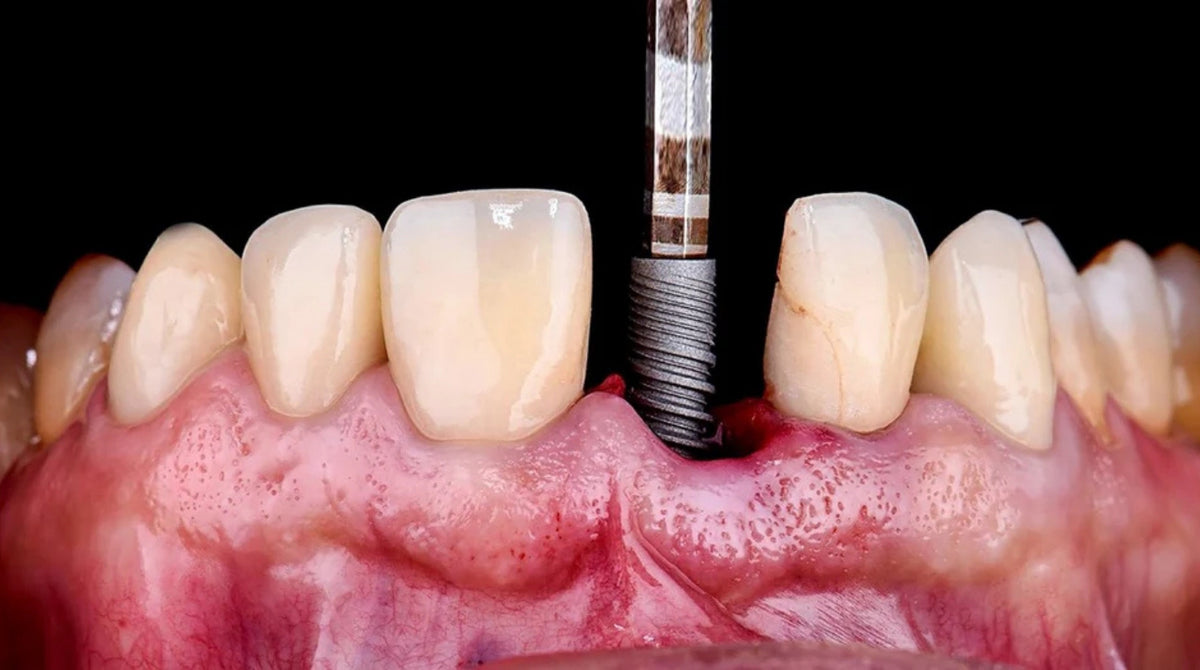
Peri-implantitis is treated step-by-step, with a non-surgical step first. This is recommended by both the European Federation of Periodontology (EFP) in 2023 and the Academy of Osseointegration and American Academy of Periodontology (AO/AAP) in 2025.1, 2 Complete resolution is difficult to achieve, however: in a multicenter trial, the disease had resolved at 38.6% of implants three years after surgery.3 Therefore, early intervention for mucositis and long-term maintenance are increasingly important today.
What is new in the treatment of peri-implantitis?
The definition and diagnostic criteria from the 2017 classification remain in force. What has changed in recent years is the view on what treatment can achieve and where intervention makes a difference. Five developments are particularly relevant to clinical practice:
- Two sets of guidelines now point in the same direction: step-by-step treatment, non-surgical first. See the section.
- The goal is resolution of the disease, not just reduced pocket depths, and new trials show that this is difficult to achieve. See the section.
- Reconstruction can provide radiographic bone gain and a better soft tissue contour in favourable defects, but not reduce inflammation in itself. See the section.
- Diabetes is linked to peri-implantitis in new registry data. See the section.
- Mucositis and maintenance are crucial to long-term outcomes, and research on home care has kept pace. See the section.
What does the new American consensus on peri-implantitis say?
The EFP S3 guideline, published by Herrera et al. in the Journal of Clinical Periodontology in 2023, is based on 13 systematic reviews and recommends step-by-step treatment: first a non-surgical step, then reassessment after 6–12 weeks and surgery if the goal has not been achieved. The goal is pocket depths ≤ 5 mm, at most one bleeding point, and no suppuration per implant.1
The AO/AAP consensus followed in 2025, published by Wang et al. in the Journal of Periodontology. It is based on 8 systematic reviews and a consensus meeting in 2024, where the panel voted on each recommendation. It is in line with the EFP on the sequence and on non-surgical treatment as the first step.2 Two differences are worth noting:
- Supplement: The AO/AAP states that supplements to non-surgical treatment of peri-implantitis may help in selected cases. This is an expert assessment; the consensus did not include a review on this particular question.2
- Reconstruction: The AO/AAP panel prefers reconstructive surgery when possible (79% agreed).2 The EFP found no evidence that any surgical technique is better than another.1 See Reconstruction.
Both documents are based on evidence of varying strength, and several recommendations are expert consensus. The meeting behind the AO/AAP was supported by implant and biomaterial companies (see Interests).2
How often is the treatment of peri-implantitis successful?
Trials today measure success as a composite primary outcome: the implant is preserved, pocket depths are low, there is at most minimal bleeding, and no suppuration. With this primary outcome, the results are more modest than many expect.
In a multicenter trial published by Derks et al. in Clinical Oral Implants Research in 2022, 138 patients received surgical treatment with or without bone substitute material. After 12 months, 16.4% and 13.5% of the implants met all success criteria, although pocket depth had been reduced by 3.7 mm in both groups.4 At the 3-year follow-up, published by Alibegovic et al. in the same journal in 2025, 14 implants (11%) had been lost, and the disease had resolved at 38.6% of the implants when one bleeding point was allowed.3
A randomised trial with 7-year follow-up, published by Isler et al. in Clinical Oral Implants Research in 2025, points in the same direction. 57 patients received reconstructive surgery for defects ≥ 3 mm. After 7 years, the treatment was successful in 23.1% and 30.8% of the patients in the two groups, and the disease had returned in 34.6% and 30.8%. Suppuration at baseline was the only factor that predicted treatment failure, with a very wide confidence interval (OR 15.45; 95% confidence interval (CI) 1.42 to 168.5).5
What this means in clinical practice. The further the disease has progressed, the harder it is to bring to resolution. This argues for early intervention, measuring the result against the EFP's primary outcome, and planning maintenance even before treatment begins.
When does reconstructive surgery make sense for peri-implantitis?
According to the EFP, access flaps with or without reconstruction can be considered for bone defects, and reconstruction is preferably suggested for intraosseous defects with a depth ≥ 3 mm (Grade B, low evidence).1 The latest trials have made the picture clearer: Reconstruction appears to provide radiographic bone gain and a better soft tissue contour, but not better control of inflammation in itself.
- Without defect selection bone substitute material provided no clear advantage over access flaps alone after 3 years in the Alibegovic trial. After 12 months, recession on the facial surface was less with the material (0.7 versus 1.1 mm).4, 3
- For defects with three or four walls Hakkers et al. found in a randomised trial with 52 patients, published in the Journal of Clinical Periodontology in 2026, that reconstruction with autologous bone, xenograft, and collagen membrane provided a better marginal bone level on X-ray after 12 months (1.65 mm; 95% CI 0.77 to 2.54) and less recession. There was no difference in pocket depth, bleeding, suppuration, or disease resolution. The authors themselves point out that a radiopaque xenograft can make bone filling appear greater than it is.6
- Material choice: In the systematic review on reconstructive treatment that the AO/AAP consensus is based on, allograft was associated with an average radiographic bone level gain of 1.14 mm and xenograft with 0.43 mm. Membranes had a more modest effect (0.56 mm).2 The figures come from different trials with different defects and protocols, so they do not show that one material is generally better than another.
The AO/AAP panel agreed (97%) that reconstructive treatment should be performed when the defect is favourable: multiple bone walls, intraosseous parts, and a depth ≥ 3 mm.2 The purpose is to regain bone and support the soft tissues; infection control comes from debridement and maintenance. Puredent sells both allografts and xenografts for bone building. The principles of bone building with membranes are described in What is GBR?, and the treatment of bone defects around teeth in Treatment of periodontal bone defects.
Which method for debriding the implant surface?
The AO/AAP concludes that there is no standard method for debriding the implant surface (85% agreed).2 One of the newer trials compared rotating titanium brushes with implantoplasty in 30 patients. Park et al. published it in the Journal of Clinical Periodontology in 2026. Pocket depth decreased by 3.6 mm with brushes and 3.3 mm with implantoplasty, and the brushes were no worse. After implantoplasty, an additional 0.7 mm of bone was lost, while the bone level remained unchanged with brushes (0.0 mm).7 The choice of method depends on the defect and the practitioner's experience.
What do the new data show about diabetes and peri-implantitis?
A Swedish registry study published by Trullenque-Eriksson et al. in the Journal of Clinical Periodontology in 2025 followed people with implants from 2010 to 2020. Peri-implantitis was more common in type 1 diabetes (OR 1.46; 95% CI 1.05 to 2.04). In type 2 diabetes, the prevalence was the same as without diabetes, but the risk of developing peri-implantitis during the period was higher (HR 1.36; 95% CI 1.02 to 1.82).8 Peri-implantitis was defined in the study as recorded treatment for the disease, so the figures reflect treated cases.8
The EFP recommends blood sugar control in patients with diabetes (Grade A, low evidence).1 The AO/AAP highlights collaboration with the patient's doctor, because blood sugar should be well regulated in connection with implant treatment.2
Why is mucositis an important treatment window?
In the AO/AAP consensus, 97% of the panel agreed that mucositis is a predisposition for peri-implantitis. The systematic review on mucositis behind the consensus found that debridement alone is effective and reliable, but that complete healing is difficult to achieve. The review found no basis for using supplements routinely, and in smokers, none of them improved the result.2 The EFP recommends professional plaque removal combined with the patient's own oral hygiene and advises against systemic and local antibiotics for mucositis.1
Therefore, attention has shifted to what the patient does at home between visits. One of the methods that has been investigated is antibacterial light therapy for home use.
Lumoral® is an antibacterial light therapy for home use, developed by the Finnish company Koite Health. The technology combines a mouthwash with the photosensitive dye indocyanine green, which binds to plaque, with blue and near-infrared light from a mouth tray. The light activates the dye and helps reduce the bacteria in the plaque.9
The EFP assessed photodynamic therapy in the form where the practitioner places a photosensitive substance in the individual pocket and illuminates it in 2023, and suggests not using it as a supplement to debridement for mucositis (Grade B).1 Lumoral® differs in that the patient rinses themselves, so the substance binds to the bacteria in the biofilm, and the tray illuminates both dental arches. The method was not included in the guideline, and the randomised trials with it have come since.
Lähteenmäki et al. investigated the method in a randomised trial, which they published in Clinical and Experimental Dental Research in 2025. 40 patients with disease around an implant (36 with mucositis and 4 with peri-implantitis) received either oral hygiene instruction alone or instruction plus daily light therapy at home for four weeks. None of them received professional treatment during the period. With light therapy, the number of bleeding measurement points around the implant fell from an average of 4.7 to 1.8 out of 6. In the control group, it did not change significantly (3.5 to 3.0).9
The trial is small and short, and the groups were tested separately before and after, not directly against each other. The control group had fewer cases of peri-implantitis from the start, and smokers were not included.9
Clinical perspective. The results point to the fact that antibacterial light therapy at home can be a relevant supplement to daily oral hygiene in patients with inflammation around implants. The trial documents less bleeding over four weeks, but does not yet provide grounds to conclude that the treatment prevents peri-implantitis or improves the long-term prognosis. It is a supplement to professional treatment, not a replacement.
What matters for whether the treatment of peri-implantitis holds?
The AO/AAP recommends maintenance every 3–4 months after treated peri-implantitis (94% agreed), adapted to the patient's risk and reassessed after the first year. The panel also agreed (93%) that effective plaque control at home is a crucial part of maintenance.2 It is in maintenance that the largest trials with antibacterial light therapy at home have been conducted, preliminarily for periodontitis and not for implants.
In the HOPE-CP trial, published by Pakarinen et al. in the Journal of Periodontology in 2026, 200 periodontitis patients in the maintenance phase were divided into regular maintenance or maintenance plus daily light therapy with Lumoral®; 184 completed. After 6 months, bleeding at probing was 12.0% with light therapy versus 17.3% without, and there was less visible plaque.10 The investigator knew the group distribution at the follow-up, and smokers and patients with poorly regulated diabetes were not included.10
In smokers, light therapy provided no additional effect. In a randomised trial with 60 smokers with stage III or IV periodontitis, published by Vakaki et al. in Clinical Oral Investigations in 2025, bleeding after 6 months was at the same level in the two groups (27.6% with and 29.6% without light therapy, no significant difference).11
How Lumoral® can be included before, during, and after implant treatment is described in the Lumoral® workflow for implant patients.
What is still unclear about peri-implantitis?
- Membrane over bone substitute: The AO/AAP panel voted to place a membrane over the graft (79% agreed), but in the underlying review, the effect of membranes on the bone level was modest.2
- Systemic antibiotics: The EFP advises against it routinely, both for non-surgical treatment and as a supplement to surgery.1 In the Derks trial, all patients received amoxicillin, and the authors of the 3-year follow-up themselves write that it contradicts the guideline.4, 3
- Supplements for mucositis: The AO/AAP panel did not reach an agreement on rinsing under the gingival margin with chlorhexidine.2
- Antibacterial light therapy for implants: The evidence for implants is one randomised trial over four weeks. The larger trials were done for periodontitis, and they were conducted by research groups affiliated with the manufacturer.9, 10 Koite Health and Associated Brånemark Osseointegration Centers (ABOC) have initiated a research collaboration that, among other things, will investigate how antibacterial home treatment can be included in the maintenance of implant patients.
What does the new evidence mean for the treatment of peri-implantitis?
Research in recent years points to the fact that the treatment of peri-implantitis is not only about the choice of surgical technique. The result also depends on when intervention is made, how effectively the inflammation is controlled, and how the patient is followed after treatment. Three areas are particularly relevant in clinical planning:
- Early intervention: The AO/AAP sees mucositis as a predisposition for peri-implantitis, and both guidelines recommend treating it with professional plaque removal and the patient's own oral hygiene.1, 2
- Surgery adapted to the defect: Reconstructive treatment can improve the radiographic bone level and the soft tissue contour in favourable defects, but does not replace effective infection control.6
- Long-term maintenance: Professional follow-up, the patient's daily plaque control, and control of risk factors such as diabetes are crucial for a stable result.2
It is within these three areas that supplementary technologies, biomaterials, and diagnostic tools can be included in the treatment.
Which products can be included in the treatment?
Antibacterial light therapy for mucositis and in maintenance
Lumoral® can be included as a supplement to the patient's oral hygiene, for mucositis and in maintenance. The evidence has been reviewed under Mucositis and Maintenance, and the course around implant treatment is described in the Lumoral® workflow. Lumoral® is available both for home use and as a clinic model that is used before the professional treatment (see the ABT protocol). The trials in this article investigated home use.
-

Lumoral® for peri-implantitis
Treatment package for intensive home treatment of peri-implantitis, severe gingivitis, and periodontitis.
See Lumoral® for peri-implantitis → -

Lumoral® before and after implant
Treatment package for a 4-month course around implant treatment.
See the package for implant patients → -

Lumoral® clinic model
Mouthguard for multiple patients in the clinic, with a disposable sleeve per patient.
See the clinic model → -

Lumoral® patient starter package
Mouthguard and mouthwash for daily home treatment as a supplement to treatment in the clinic.
See the patient's starter package →
Bone substitute for reconstructive surgery
Bone substitute material may be considered for favorable defects. See Reconstruction for what the studies show.
-

maxgraft® cortico-cancellous granules
Human allograft in granule form, among other things for smaller peri-implant defects.
See maxgraft® → -

DIZG cortico-spongiosa granules
Fine human allograft for filling small bone defects, also around implants.
See the DIZG granules → -

Where can you learn the techniques?
Surgical technique and handling of biomaterials are learned through practical training. Puredent holds courses, among other things, in the handling of bone and soft tissue in implant treatment.
See upcoming coursesFrequently asked questions about the treatment of peri-implantitis
What is new in the treatment of peri-implantitis?
An American consensus from 2025 supplements the EFP's guideline from 2023, and both recommend stepwise treatment with non-surgical treatment first. Trials with cessation of the disease as an endpoint show modest success rates, and the focus has shifted towards mucositis, maintenance, and risk factors such as diabetes.1, 2
How often is surgical treatment of peri-implantitis successful?
Does bone substitute give better results in peri-implantitis?
How often should a patient come in for maintenance after peri-implantitis?
The AO/AAP consensus recommends maintenance every 3rd-4th month after treated peri-implantitis, adapted to the patient's risk and reassessed after the first year. Effective plaque control at home is a crucial part of maintenance.2
Can Lumoral be used with implants?
In a randomized trial with 40 implant patients, most with mucositis, bleeding around the implant decreased after four weeks of antibacterial light therapy at home with Lumoral® as a supplement to oral hygiene, while it did not change significantly with oral hygiene alone. The trial was small and short, and light therapy is a supplement to professional treatment.9
Authors' and Puredent's interests
We disclose the authors' and Puredent's interests, so you can assess the sources yourself.
- Source 9, 10 and 11 (antibacterial light therapy): One of the authors is chairman of the board or co-founder and shareholder in Koite Health, which develops the equipment. In source 10 and 11, the company provided the equipment.
- Source 2: The consensus meeting was supported by implant and biomaterial companies, and the participants receive honoraria from such companies.
- Source 4: The trial was funded by the Osteology Foundation.
- Puredent distributes the equipment for antibacterial light therapy used in source 9, 10 and 11, as well as bone substitute materials and blood sugar tests.
Sources
- Herrera D, Berglundh T, Schwarz F, Chapple I, Jepsen S, Sculean A, et al. Prevention and treatment of peri-implant diseases: The EFP S3 level clinical practice guideline. J Clin Periodontol. 2023;50(Suppl 26):4-76. DOI
- Wang HL, Avila-Ortiz G, Monje A, Kumar P, Calatrava J, Aghaloo T, et al. AO/AAP consensus on prevention and management of peri-implant diseases and conditions: Summary report. J Periodontol. 2025;96(6):519-541. DOI
- Alibegovic L, Trullenque-Eriksson A, Ortiz-Vigón A, Guerrero A, Donati M, Bressan E, et al. Bone Substitute Material in the Surgical Therapy of Peri-Implantitis: 3-Year Outcomes of a Randomized Controlled Trial. Clin Oral Implants Res. 2025;36(4):436-448. DOI
- Derks J, Ortiz-Vigón A, Guerrero A, Donati M, Bressan E, Ghensi P, et al. Reconstructive surgical therapy of peri-implantitis: A multicenter randomized controlled clinical trial. Clin Oral Implants Res. 2022;33(9):921-944. DOI
- Isler SC, Soysal F, Ceyhanli T, Unsal B, Imber JC, Roccuzzo A. Long-Term Treatment Outcomes of Peri-Implantitis Reconstructive Therapy: 7-Year Survival and Success of a Randomized Clinical Trial. Clin Oral Implants Res. 2025;36(10):1202-1218. DOI
- Hakkers J, de Waal YCM, Gareb B, Meijer HJA, Raghoebar GM. Surgical Reconstructive Peri-Implantitis Treatment for 3- and 4-Wall Bone Defects: A Single-Blind Randomised Controlled Trial With a 1-Year Follow-Up. J Clin Periodontol. 2026;53(6):933-946. DOI
- Park SH, Kim DB, Kim DM, Sanz-Martin I, Sanz-Sanchez I, Derks J, et al. Implantoplasty vs. Rotating Titanium Brushes in the Surgical Treatment of Peri-Implantitis: A 1-Year Randomised Controlled Clinical Trial. J Clin Periodontol. 2026;53(2):244-255. DOI
- Trullenque-Eriksson A, Bitencourt FV, Tomasi C, Berglundh T, Derks J. Association Between Diabetes and Peri-Implantitis: Evidence From a Swedish Register-Based Study. J Clin Periodontol. 2025;52(12):1650-1661. DOI
- Lähteenmäki H, Pätilä T, Räisänen IT, Kalliala R, Sorsa T. Peri-Implant Diseases: Enhanced Antibacterial Photodynamic Therapy. Clin Exp Dent Res. 2025;11(3):e70146. DOI
- Pakarinen S, Välimaa H, Heikkinen AM, Noponen M, Alapulli H, Saarela RKT, et al. A randomized controlled trial of home-applied dual-light photodynamic therapy during supportive periodontal care (HOPE-CP study). J Periodontol. 2026;97(4):720-731. DOI
- Vakaki C, Fragkioudakis I, Pätilä T, Sakellari D. Regular home use of dual-light photodynamic therapy as an adjunct to non-surgical periodontal treatment in smokers: a single-center randomized controlled clinical trial. Clin Oral Investig. 2025;29(12):553. DOI

Share:
Resorbable vs. non-resorbable membrane in bone augmentation
Allograft, xenograft or alloplast: which do you choose when?