


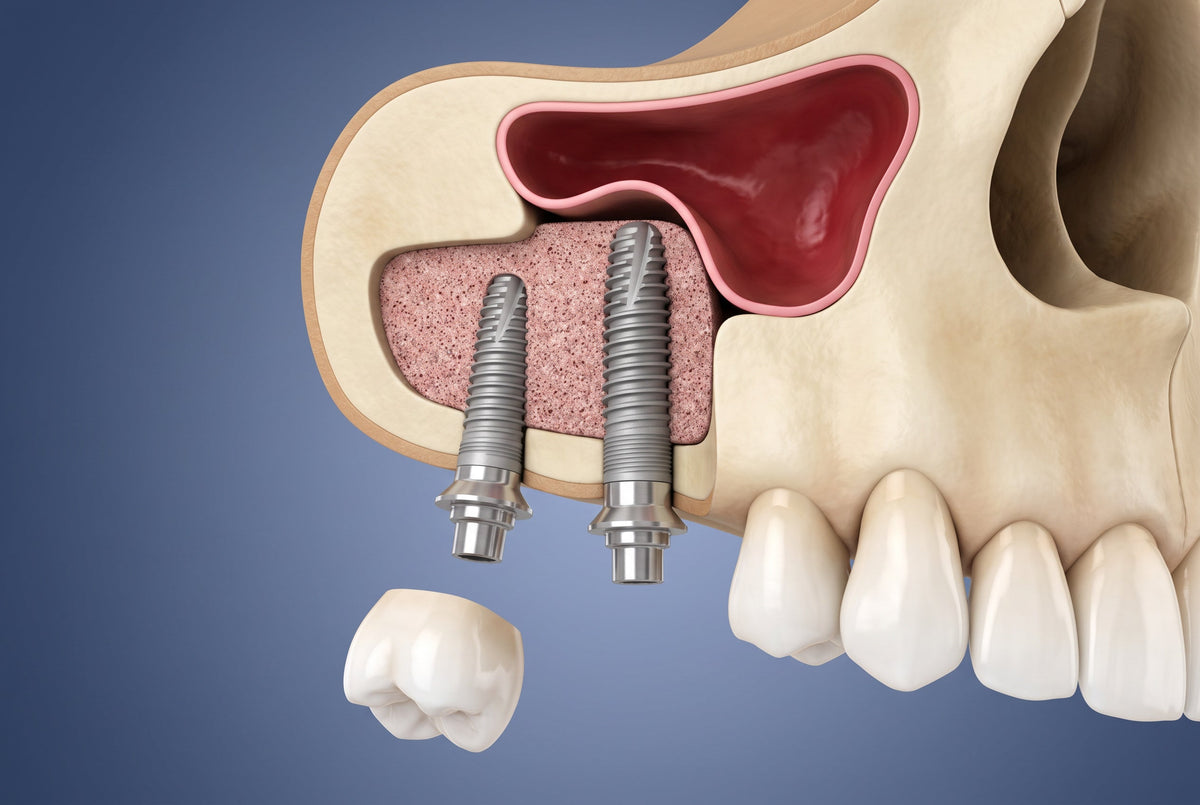
There are two sinus lift techniques: lateral window, where the sinus membrane is lifted through an opening in the side of the jawbone, and crestal technique, where it is lifted through the implant drilling. A narrative review by Alsharekh et al. in Cureus summarizes that the lateral technique provides more height, while the crestal technique is less invasive. The choice depends primarily on the remaining bone height, but also on the sinus anatomy and the practitioner's experience.1
What is the difference between lateral and crestal sinus lift?
Lateral window
In the lateral technique, also known as direct sinus lift, a bone window is opened in the lateral wall of the jawbone. The sinus membrane (Schneiderian membrane) is detached and lifted, and the space beneath it is filled with bone material. The Alsharekh review describes it as the most commonly used method for sinus lift.1 The implant can be placed at the same time or in a later session. According to a review by Stacchi et al. in Clinical Implant Dentistry and Related Research, it depends primarily on how good primary stability the remaining bone can provide the implant.4
The window can be prepared with rotary instruments or with piezosurgery. In a randomized split-mouth study with 36 patients, as reported by the Alsharekh review, there were four perforations in each group, and the operation took longer with piezosurgery. The review nevertheless highlights piezosurgery when the remaining bone height is under 3 mm.1 The choice of instrument for the window therefore cannot be made based on the perforation rate in that study alone. To detach and lift the sinus membrane through the window, instrument sets such as the Salama Sinus Lift Kit are available. You can find more instrument sets and hand instruments under surgical instruments.
Crestal technique
In the crestal technique, also known as indirect or transalveolar sinus lift, the implant site is prepared up to the sinus floor, and the floor is lifted with osteotomes through the drilling. The implant is typically placed in the same session.1, 2 There are several variants, including with hydraulic pressure, balloon, and osseodensification, where special drills compress the bone while lifting the sinus floor.1
The osteotomes are traditionally driven with a hand mallet, and the Alsharekh review mentions that osteotomes and hammers are often associated with hearing and balance issues.1 The osteotomes can also be driven electromagnetically, with strikes of controlled force and a strike time of 80 microseconds. This is the principle of the Magnetic Mallet.3
With the Magnetic Mallet, the implant survival rate in crestal sinus lift was the same as with a hand mallet, and no patients in the Magnetic Mallet groups developed benign paroxysmal positional vertigo (BPPV). This is shown by a systematic review by Bennardo et al. in the Journal of Personalized Medicine of 14 clinical studies of the instrument. For crestal sinus lift, the findings are based on two prospective studies with a total of 72 patients and 130 implants:3
- Implant survival: 98% after two years. In the study that had a control group with a hand mallet, the survival was 98.33% in both groups.3
- BPPV in sinus lift: In the same study, 2 out of 40 patients with a hand mallet developed BPPV, compared to none of the 40 with the Magnetic Mallet.3
- BPPV across procedures: In all the review's control groups, 7 out of 133 patients developed BPPV: 2 after sinus lift, 4 after preparation of the implant site, and 1 after ridge expansion.3
None of the studies were randomized, the protocols were different, and 11 of the 14 studies have the same first author (see interests). The authors therefore conclude that the results are not enough to show the effect of the Magnetic Mallet, and call for randomized trials with more patients.3
Clinical perspective. The studies do not provide grounds to expect better implant survival with the Magnetic Mallet than with a hand mallet. The difference lies in the genes. The Magnetic Mallet may be considered as an alternative to the hand mallet in crestal sinus lift when you want to avoid the issues associated with strikes from a hand mallet. The instrument has been studied with osteotomes in crestal sinus lift, not in lateral window, and none of the trials in the Starch-Jensen meta-analysis below included it.2, 3
Lateral vs. crestal sinus lift: what do the studies show?
- Bone gain
- Lateral: stated as 6-12 mm bone height after the procedure. Crestal: lifting of the sinus floor by up to around 5 mm.1
- Procedure
- Lateral: bone window in the lateral wall of the jawbone, with more pronounced pain and swelling, which subsides after around one week. Crestal: through the implant drilling and less invasive.1
- Complications
- Perforation of the sinus membrane is the most common, in lateral technique in around every fifth case. In crestal technique, osteotomes and hand mallet are associated with hearing and balance issues.1
- Implant
- Lateral: simultaneously or in a later session, depending on the primary stability. Crestal: typically simultaneously.1, 2, 4
The numbers in the box are approximate. They are the Alsharekh review's own summaries, not the result of a combined analysis, and they do not say what the individual procedure provides. The perforation rate in lateral technique is taken from two systematic reviews. In the individual studies the review reports, the difference in bone height is smaller, e.g., 6.19 mm with direct versus 5.34 mm with indirect technique in one comparative study.1
In the few randomized trials that directly compare the techniques, the implant survival was the same in the short term. Lateral window provided more bone height in one small trial, while crestal sinus lift with osseodensification resulted in fewer perforations, shorter operation time, and less pain in another. This is shown by a meta-analysis by Starch-Jensen et al. in the Journal of Oral and Maxillofacial Research, which combined six randomized trials where crestal sinus lift with osseodensification was compared with osteotome technique or lateral window. Four of the trials compared with osteotome technique and two with lateral window, with 17 patients in each group in total.2
Crestal with osseodensification vs. lateral window (two trials):
- Implant survival: All implants survived in both groups after 6-12 months.2
- Bone height in sinus: One trial with 7 patients in each group, only published as a preprint, found significantly more bone height with lateral window, on average 10 mm versus 5.3 mm.2
- Complications and course: One trial with 10 patients in each group found perforation of the membrane in 1 out of 10 with the crestal technique versus 4 out of 10 with lateral window, shorter operation time (32.9 versus 71.1 minutes) and less pain up to the third day after the procedure.2
Crestal with osseodensification vs. osteotome technique (four trials): The meta-analysis found no significant difference in bone gain in the sinus (three trials) and higher primary stability with osseodensification (three trials). In one trial with 5 patients in each group, all patients with osteotome technique had headaches and dizziness, compared to none with osseodensification.2
The authors assessed the evidence as low according to Grading of Recommendations Assessment, Development and Evaluation (GRADE) with a high risk of bias, partly because the trials lacked hidden allocation and blinding. They conclude that randomized long-term trials are needed before one technique can be considered better than the other.2 The trials do not say how the osteotomes were driven, and none of them included the Magnetic Mallet.
Clinical significance. The trials do not provide grounds to choose a technique based on implant survival. Lateral window may be considered when more bone height is needed, and crestal technique when a less invasive procedure is valued. The choice depends primarily on the remaining bone height and sinus anatomy (see choice of technique). The instruments for the crestal technique are found under osteotomes and Magnetic Mallet.
When can which sinus lift technique be considered?
The Alsharekh review sets a rule of thumb based on the remaining bone height between the ridge and the sinus floor, and Stacchi et al. point to sinus anatomy and short implants. Overall by clinical situation:1, 4
- ≤ 3 mm remaining bone height: lateral window and implant in a later session.1
- > 3 mm and ≤ 5 mm: lateral window with simultaneous implant or crestal technique with a simultaneous short implant.1
- > 5 mm and ≤ 9 mm: crestal technique with a simultaneous implant in standard length.1
- Polyps, multiple septa, or new procedure after a previous perforation: lateral window may be preferable.1
- Wide sinus: new bone is formed primarily from the sinus floor and the walls toward the middle, so it is generally easier to achieve new bone in a narrow sinus than in a wide one. The remaining bone height is only moderately associated with the total bone gain.4
- Short implants instead of sinus lift: in four meta-analyses that Stacchi et al. refer to, short implants in the existing bone gave results in the medium and long term that were comparable with longer implants combined with sinus lift.4
The rule of thumb goes up to 9 mm remaining bone height, and the review does not say what applies above that. The list is an orientation, not a treatment protocol, and the final assessment is the practitioner's.
What bone material is used in sinus lift?
According to Stacchi et al., there is no one material that is best in all clinical situations. Autologous bone contains cells that form new bone faster, but it resorbs over time. Allogene, xenogene and synthetic materials are only resorbed to a limited extent and thus preserve volume better, but in animal studies they consolidate more slowly.4 The review states a typical healing time of 6-9 months: around 6 months with autologous or allogene bone and longer with xenogene and synthetic materials.4 The differences between the material classes are reviewed in Allograft, xenograft or alloplast: what do you choose when?
Whether the lateral window should be covered with a barrier membrane is not agreed upon according to Stacchi et al. Clinical trials and meta-analyses have not found a significant difference in implant results with or without a membrane, but individual studies suggest that a membrane over the window can increase bone formation and implant survival.4 How membranes work in bone building is stated in the article about guided bone regeneration (GBR) and membranes.
Clinical significance. The choice of material may depend on whether fast consolidation or preserved volume is valued highest, and how long a healing time can be accepted. Whether the window is covered with a membrane is an assessment in the individual case.
Platelet concentrates in the sinus
Concentrated growth factors (CGF) alone gave a significantly higher proportion of new bone than bovine xenograft after 6 months in a small split-mouth trial, but the area of new bone itself was not significantly different, and the xenograft side had significantly more residual material. CGF is a platelet concentrate in the same family as platelet-rich fibrin (PRF). The trial, which Ghasemirad et al. published in the Journal of Medicine and Life, was randomized and double-blinded and included lateral sinus lift in 9 patients (18 sinuses). The proportion of new bone was measured relative to the original bone, and the authors attribute the residual material to the slow resorption of the xenograft.5
The study was small and only measured histology, not implant results, and the authors call for larger studies with longer follow-up. They themselves mention, referring to another study, that implants survive worse when PRF is used alone in sinus lift with simultaneous implant, but that PRF has given good results in combination with allograft.5
Clinical significance. Platelet concentrate alone is not established practice in sinus lift, while PRF may be considered in combination with a bone replacement material such as allograft. The equipment is found under equipment for PRF. How PRF is produced and works is stated in What is PRF?, and the liquid variant in i-PRF: what is liquid PRF?
Instruments and materials for sinus lift
The instrument set belongs to the lateral window, Magnetic Mallet and the osteotomes to the crestal technique (see techniques), and the materials are reviewed under bone material.
-

Salama Sinus Lift Kit
Instrument set for lateral sinus lift and elevation of the sinus membrane.
See Salama Sinus Lift Kit → -

Magnetic Mallet Starter-Kit
Electromagnetic hammer with foot pedal and handpiece. Osteotomes are chosen separately.
See Magnetic Mallet Starter-Kit → -

-

maxgraft® cancellous
Allogene bone granules from cancellous human donor bone.
See maxgraft® cancellous → -

collprotect® membrane 20 x 30 mm
Natural porcine dermis collagen membrane for bone and soft tissue regeneration.
See collprotect® membrane →
Webinars on sinus lifts
botiss has recorded webinars with clinicians who use the materials for sinus lifts. They are available at botiss and require a free botissPLUS login. You can find all the webinars on the biomaterials webinar page.


Frequently asked questions about sinus lifts
When is a lateral sinus lift used?
A lateral sinus lift may be considered when the remaining bone height is low. The Alsharekh review suggests a lateral window when there is ≤ 3 mm of remaining bone height and as one of two options when there is > 3 mm and ≤ 5 mm.1 The sinus anatomy, e.g. septa, is also part of the assessment.
How much bone can be gained with a crestal sinus lift?
The Alsharekh review summarizes that a crestal sinus lift can elevate the sinus floor by up to approximately 5 mm and states 6-12 mm of bone height with a lateral window. The figures are approximate, and in individual studies the difference is smaller.1
Is a crestal sinus lift less traumatic for the patient?
The Alsharekh review describes pain and swelling as more pronounced after the lateral technique than after the crestal technique.1 In one of the trials in the Starch-Jensen meta-analysis, patients had less pain up to the third day after a crestal sinus lift with osseodensification than after a lateral window.2
How long does a sinus lift require for healing?
Stacchi et al. state a typical healing time of 6-9 months: approximately 6 months with autologous or allogeneic bone and longer with xenogeneic and synthetic materials.4
Can the Magnetic Mallet be used for crestal sinus lifts?
Yes. The Bennardo review includes two prospective studies of crestal sinus lifts with the Magnetic Mallet. In the study with a control group, the implant survival rate was the same as with a hand mallet, and 2 out of 40 patients with a hand mallet developed BPPV, compared to none of the 40 with the Magnetic Mallet.3
Can short implants be an alternative to sinus lifts?
This may be considered. Stacchi et al. refer to four meta-analyses where short implants in existing bone provided mid- and long-term results comparable to longer implants combined with sinus lifts.4
Authors' and Puredent's interests
We disclose the authors' and Puredent's interests so you can assess the sources yourself.
- Source 1-5: The authors have declared that they have no conflicts of interest.
- Source 3: 11 of the 14 studies in the review have Crespi as the first author, and he is a co-author on two more, so the clinical evidence for the instrument comes predominantly from one research group.3
- Puredent distributes the electromagnetic instrument investigated in source 3, as well as bone replacement materials, membranes, and equipment for PRF.
Sources
- Alsharekh MS, Almutairi AA, Jahlan AS, et al. Evolving Techniques and Trends in Maxillary Sinus Lift Procedures in Implant Dentistry: A Review of Contemporary Advances. Cureus. 2024;16(10):e71424. DOI
- Starch-Jensen T, Østergaard KB, Bruun NH, Shino IL, Hallund MH. Transcrestal Maxillary Sinus Membrane Elevation using Osseodensification Compared with Alveolar Ridge Augmentation using the Lateral Window or Osteotome Technique: a Systematic Review and Meta-Analysis. J Oral Maxillofac Res. 2025;16(2):e1. DOI
- Bennardo F, Barone S, Vocaturo C, Nucci L, Antonelli A, Giudice A. Usefulness of Magnetic Mallet in Oral Surgery and Implantology: A Systematic Review. J Pers Med. 2022;12(1):108. DOI
- Stacchi C, Coyac BR, Helms JA. Biomechanical Basis for Bone Healing and Osseointegration of Implants in Sinus Grafts. Clin Implant Dent Relat Res. 2025;27(1):e13424. DOI
- Ghasemirad M, Chitsazi MT, Faramarzi M, Roshangar L, Babaloo A, Chitsazha R. Histological examination of the effect of concentrated growth factor (CGF) on healing outcomes after maxillary sinus floor augmentation surgery. J Med Life. 2023;16(2):267-276. DOI

Share:
Atraumatic extraction: why preserve the alveolus?
What is a magnesium membrane?