


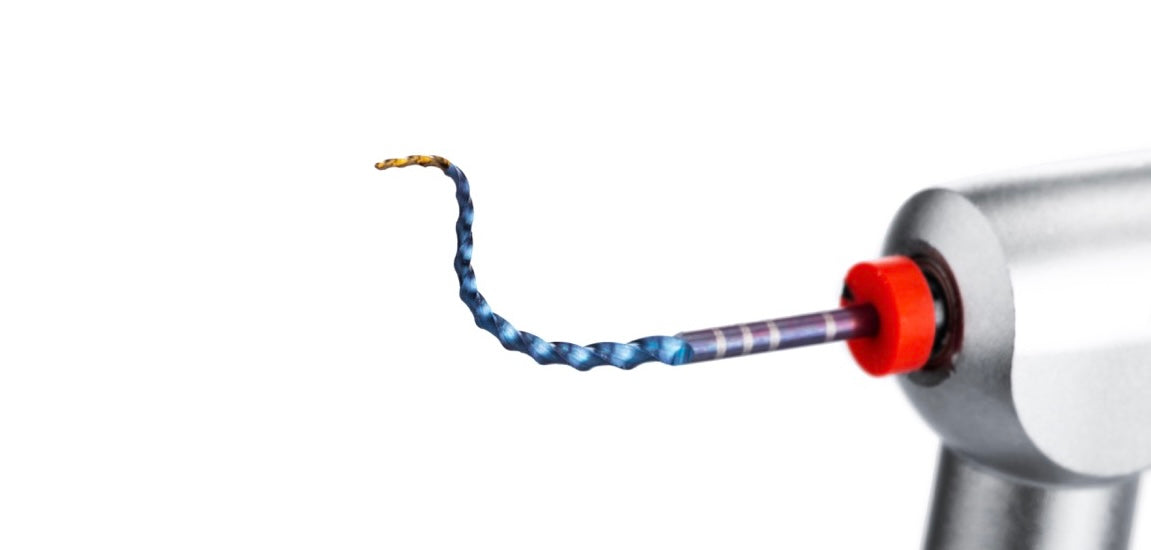
NiTi root canal files are machine-driven nickel-titanium instruments used to prepare the root canal. The alloy is more flexible than stainless steel, so the files can follow curved canals. The systems differ in heat treatment, taper, and motion, i.e., rotation or reciprocation. In the laboratory, heat-treated files withstand more cyclic fatigue, but high fatigue resistance is not the same as high flexibility.
What are NiTi root canal files?
NiTi files are root canal instruments made of a nickel-titanium alloy. The alloy was introduced in endodontics in 1988 and has since become the standard for machine preparation because it is far more flexible than stainless steel. Therefore, the files can have a greater taper and still follow a curved canal. This is described by Arias and Peters in a narrative review in the International Endodontic Journal from 2022, where they also note that there were over 200 brands of file systems.1
The review divides the files into seven generations, the last two of which are the authors' own proposal. The development can be grouped into three tracks, which the rest of the article follows: design (cross-section and taper), heat treatment of the alloy, and motion (reciprocation and the single-file concept). In addition, there are new manufacturing methods such as spark erosion (electrical discharge machining, EDM) and machine files for glide path and revision.1 The review emphasizes that no instrument processes the entire canal wall, and that irrigation becomes even more important with single-file techniques.1
Why does a NiTi file break?
A narrative review published by Kwak et al. in Materials in 2022 distinguishes between two fracture mechanisms:2
- Cyclic fatigue occurs when the file rotates freely in a curved canal. The metal is alternately subjected to compression and tension where the file bends the most, until a crack develops.
- Torsional fracture occurs when the tip gets stuck while the rest of the file continues to rotate.
Torque describes the rotational load the file is subjected to during preparation. According to the review, it increases with the contact surface between the file and the canal wall and with the canal's curvature, and conventional files without heat treatment were most affected in curved canals. Fast in-and-out movements (pecking) resulted in higher maximum torque, while a brushing motion required less. Slow movements, on the other hand, prolong preparation time and increase the total torque.2
According to the studies the review refers to, it is successful in removing a broken fragment in 55-80% of cases, and removal can cost extra dentin. Therefore, the choice of file is largely about preventing the fracture.2
What do heat treatment and taper mean?
Heat treatment, e.g., M-Wire, CM-Wire, Blue, and Gold, shifts the alloy toward the martensitic phase, which is more flexible than the austenitic, and according to Arias and Peters, significantly increases fatigue resistance. However, the review points to a source of error: some modern alloys change phase near body temperature, so fatigue tests at room temperature may yield overly optimistic results.1 It is worth remembering when reading the studies of the individual files further down.
Taper is the other handle. Two of the studies below associate a lower taper with less removed material in the pericervical area and slightly lower stresses in the dentin.5, 7 All the files from Zarc Endo, which Puredent carries, are heat-treated, and several have a taper of 4 or 5%.
Rotating or reciprocating root canal files?
A rotating file turns all the way around in one direction. A reciprocating file turns back and forth alternately, furthest in the cutting direction, typically 150-170°, and shorter back, typically 30-50°, so the file is released before it gets screwed in.1
A meta-analysis published by De Pedro-Muñoz et al. in the Journal of Clinical Medicine in 2024 found that reciprocating files withstood significantly more cycles before fracture than rotating ones, but that the difference in time to fracture was not significant. The analysis combined 16 laboratory studies in artificial stainless steel canals:3
- 1,444 vs. 4,156 average number of cycles before fracture, rotating vs. reciprocating (10 studies, p = 0.035)
- 475 vs. 839 s time to fracture, rotating vs. reciprocating (8 studies, not significant, p = 0.134)
The authors themselves point out that the number of cycles is difficult to determine precisely for reciprocating files, which is why they are normally tested on time. The results varied greatly from study to study, alloy and design were not included, and the tested systems were primarily older, e.g., WaveOne, Reciproc, ProTaper, and OneShape. The shape of the canal also mattered a lot: in canals with double curvature, the files broke much faster than in canals with a single curvature.3
The motion also has other consequences. A meta-analysis of eight studies published by Ahmad et al. in the Australian Endodontic Journal in 2022 found a tendency toward more apical extrusion of debris with reciprocating single-file systems (WaveOne and Reciproc) than with rotating ones (Neoniti and OneShape).4 Adaptive motions, where the motor switches from rotation to reciprocation with increasing load, resulted in lower torque than continuous rotation, according to the Kwak review.2 If you want to see the reciprocating systems side by side, read the comparison of WaveOne Gold, Reciproc Blue, and Excalibur.
File sequences: from crown-down to single-file
Arias and Peters describe four principles for the order of the files: step-back with files without taper, crown-down with conical files from coronal to apex, single-length with rotation, where each file in the sequence is led to the working length, and single-length with reciprocation, where one file shapes the entire canal. The single-file concept is simple and has a shorter learning curve, but results in the same final shape in canals that look very different. The review mentions individual studies suggesting more apical transportation in moderately curved canals and less bacterial reduction with single-file techniques than with sequences of multiple files.1
What do the studies of the Zarc files show?
The laboratory studies of the files from Zarc Endo show high fatigue resistance for Excalibur and BlueShaper PRO, but they also show that fatigue resistance and flexibility do not go together, and that a PRO version is not the strongest in all aspects. The studies were done in steel canals, resin blocks, and 3D-printed teeth and say something about mechanical properties and shaping, not about healing or tooth survival. The overview here gathers the findings, and the sections below review each study.
| File system | Design | Findings in favor | Findings against, and caveats |
|---|---|---|---|
| Excalibur | Reciprocating single-file, gold-treated, 5% taper | Most cycles before fracture in two studies with 7 and 20 systems.5, 6 Removed less material pericervically than Reciproc Blue.7 | Among the least flexible in bending tests. The cycles were calculated at a higher speed than the Reciproc files.5 |
| SlimShaper | Three rotating files, 4% taper, three heat treatments | ZS2 and ZS3 lasted significantly longer than the PRO versions.8 | Six files per size, tested in a steel canal.8 |
| SlimShaper PRO | Same geometry as SlimShaper, according to the manufacturer, changed heat treatment in the tip | No more apical transportation than SlimShaper.9 | Shorter time to fracture than SlimShaper for ZS2 and ZS3. The higher cutting ability has not been measured.8 |
| BlueShaper PRO | Rotating, gold-treated tip and blue-treated remainder | Lasted significantly longer than BlueShaper and BlueShaper Gold in a steel canal.10 | In 3D-printed molars, BlueShaper Gold was the strongest in most measures.10 |
Excalibur: reciprocation and 5% taper
Excalibur had the most cycles before fracture in two laboratory studies. In the study published by Neto et al. in the International Endodontic Journal in 2026, 441 files from seven reciprocating systems were tested. Excalibur 25/.05 had the highest number of cycles, and measured in time, Excalibur and Reciproc Minima were at the top without a significant difference. The number of cycles is calculated based on the motor's speed, and Excalibur ran at 500 rpm compared to 300 rpm for the Reciproc files. Excalibur, on the other hand, was among the files that required the most force to bend, i.e., the less flexible. In the study's computer simulation, the more conservative preparations, including with Excalibur, resulted in slightly lower stresses in the dentin.5
In the study published by Aranguren et al. in Materials in 2024, 400 files from 20 systems were tested in a steel canal with 60° curvature at room temperature. Excalibur had the highest average number of cycles and the longest time before fracture, followed by Reciproc Blue. The authors assess that it is probably due to the heat treatment and the motion, and that the low taper may have contributed.6
In the study published by Medina-Gil et al. in Dentistry Journal in 2025, 40 3D-printed mandibular premolars with two canals were prepared with four reciprocating systems. Excalibur removed significantly less material in the pericervical area than Reciproc Blue, 15.09% vs. 22.24%, and the authors associate it with the lower taper. There were no significant differences in the proportion of unprepared canal walls. The 3D-printed resin is softer than dentin, according to the authors.7 Excalibur is also available as Excalibur PRO with nanocoating, but it is not included in the studies above.
Clinical perspective. The studies speak for Excalibur when fatigue resistance and a conservative coronal preparation weigh heavily. The lower flexibility is worth knowing in strongly curved canals. The studies do not show whether the higher fatigue resistance results in fewer fractures in the clinic.
SlimShaper and SlimShaper PRO: 4% taper for curved canals
SlimShaper lasted longer than SlimShaper PRO for two of the three file sizes, while the PRO version did not result in more apical transportation. SlimShaper is a rotating sequence of three files with 4% taper, where each file has its own heat treatment (Gold, Pink, and Blue), and the manufacturer has designed it for curved and sclerosed canals. SlimShaper PRO has the same geometry, but according to the manufacturer, a changed heat treatment in the tip.
In the study published by Scolaro et al. in Dentistry Journal in 2026, six files of each size were tested in a steel canal with 45° curvature. ZS1 performed equally in the two sequences, while ZS2 and ZS3 from SlimShaper lasted significantly longer than the PRO versions. The heat analysis showed more austenite in ZS2 PRO, and according to the authors, this explains the difference. They assess that SlimShaper PRO may be relevant where more cutting ability is needed, but the cutting ability was not measured.8
In the study published by Puleio et al. in the International Journal of Dentistry in 2026, 44 curved resin blocks were prepared. The average apical transportation was 0.084 mm with SlimShaper and 0.086 mm with SlimShaper PRO, without a significant difference.9 How SlimShaper compares to another minimally invasive system can be read in the comparison of TruNatomy and SlimShaper.
Clinical perspective. If fatigue resistance weighs heavily, the studies do not give reason to choose the PRO version, for in the Scolaro study, it was the opposite for ZS2 and ZS3. The changed tip did not result in more apical transportation. The higher cutting ability, which the PRO version is developed for, is not yet documented.
BlueShaper PRO: two heat treatments in one file
BlueShaper PRO lasted the longest in a fatigue test in a steel canal, but was not the strongest in the 3D-printed teeth. According to the study, the outermost 4 mm are gold-treated and the rest of the file is blue-treated. In the study published by Aparicio et al. in Dentistry Journal in 2025, it was compared with two sister files with the same geometry, BlueShaper (only blue) and BlueShaper Gold (only gold), with 20 files in each group. In a steel canal with 40° curvature, BlueShaper PRO lasted significantly longer than both, 73.85 seconds vs. 65.62 for BlueShaper and 67.45 for BlueShaper Gold. In 3D-printed molars, BlueShaper Gold prepared the most canals before fracture (7.5 on average), followed by BlueShaper PRO (5.67) and BlueShaper (5.00), and Gold was also the strongest in most other measures. The fragments were the same length in the three groups, and the authors interpret it as the transition between the two heat treatments not being a weak point. They emphasize that the number of canals is a comparison measure and not a recommendation for reuse.10 Studies of BlueShaper vs. ProTaper are gathered in the comparison of ProTaper and BlueShaper.
Clinical perspective. The study shows that the combined heat treatment does not weaken the file at the transition, and that it lasted the longest in the steel canal. It does not show that BlueShaper PRO is the strongest in all aspects, for in the 3D-printed teeth, the pure gold treatment performed best.
How the studies should be read. All the studies are laboratory studies, and several compare the Zarc files with each other rather than with other brands. The results depend on the test setup, e.g., the canal's curvature, the temperature, and the motor's speed. We have not found clinical studies that compare the Zarc files with other files on healing or tooth survival, and we have not found studies of the Z-Glider EVO glide path file. The authors' ties to the manufacturers are under Interests.
What should be emphasized when choosing a NiTi system?
Overall, the sources point to five conditions that are worth having in mind when choosing and comparing file systems:
- Fatigue resistance and flexibility are two different properties. Excalibur had the most cycles before fracture, but was among the less flexible in the same study.5 Arias and Peters refer to that martensitic instruments should be preferred in strongly curved canals and with double curvature.1
- Taper affects how much is removed. In the studies that have investigated it, the lower taper is associated with less removed material pericervically and slightly lower stresses in the dentin.5, 7 If a conservative preparation is desired, files with 4 or 5% taper, such as SlimShaper and Excalibur, can be considered.
- Only compare results from the same test setup. Temperature, curvature, and speed change the results: testing at room temperature may overestimate alloys that change phase near body temperature,1 the files broke much faster in canals with double curvature,3 and different speeds affect the number of cycles.5
- A newer version is not necessarily better for all canals. SlimShaper lasted longer than SlimShaper PRO for ZS2 and ZS3,8 and BlueShaper PRO was the strongest in the steel canal, but not in the 3D-printed teeth.10
- The technique also affects the load. A glide path reduces the risk of torsional fracture because the file is not screwed in and locked in the canal, and a light apical pressure reduces the torque.1, 2 There are machine glide path files, e.g., Z-Glider EVO.
Limitations. Almost all evidence on the properties of the files comes from the laboratory. The material in the artificial canals is not the same as dentin: the Kwak review points out that the resin blocks used in many torque studies are harder than dentin and therefore can produce higher torque,2 while the 3D-printed resin in the Medina-Gil study is softer than dentin.7 Arias and Peters conclude that well-conducted clinical studies are rare, and that long-term studies comparing mechanical techniques in terms of tooth survival and periapical healing are lacking. They also call for a common minimum standard for what a file should be able to withstand.1
File systems from Zarc Endo
Puredent carries the file systems from Zarc Endo. The descriptions on the cards are the manufacturer's own. What the studies have shown about the files is explained in the section What do the studies show about Zarc files?
-

BlueShaper PRO
Rotary file system with two heat treatments in the same file. Eight files from ZXS to Z7.
See BlueShaper PRO → -

SlimShaper
Three rotary files with 4% taper and their own heat treatment, designed for curved and sclerosed canals.
See SlimShaper → -

SlimShaper PRO
Same geometry as SlimShaper with 4% taper and a modified heat treatment in the tip.
See SlimShaper PRO → -

Excalibur
Reciprocating single-file with gold heat treatment and 5% taper in four sizes.
See Excalibur → -

Frequently Asked Questions
What is the difference between rotary and reciprocating root canal files?
A rotary file rotates fully in one direction. A reciprocating file rotates back and forth alternately, mostly in the cutting direction. In a meta-analysis of laboratory studies, reciprocating files withstood significantly more cycles before breaking, but the difference in time to break was not significant.3 The number of cycles is also difficult to determine precisely for reciprocating files.
Why do NiTi files break?
Either due to cyclic fatigue, when the file is bent again and again in a curved canal, or due to torsion, when the tip gets stuck while the rest of the file rotates. The stress on the file increases with the curvature of the canal and with the contact area between the file and the canal wall.2
What does heat treatment do to a NiTi file?
Heat treatment shifts the alloy towards the martensitic phase, which is more flexible. Heat-treated files last significantly longer in fatigue tests than conventional NiTi files. Some alloys change phase close to body temperature, so testing at room temperature may overestimate them.1
Why create a glide path before the NiTi files?
Does a specific file system provide better clinical results?
This has not yet been determined in clinical studies, as well-conducted long-term studies comparing file systems in terms of healing and tooth survival are rare. What has been documented are the differences in the laboratory: heat-treated files withstand more fatigue than conventional NiTi, and a glide path reduces the risk of torsional fracture. According to Arias and Peters, martensitic files should be preferred in strongly curved canals.1
Have Zarc files been investigated in studies?
Yes, in laboratory studies. Excalibur had the highest number of cycles before breaking in two studies with seven and 20 systems respectively, but was among the less flexible.5, 6 BlueShaper PRO lasted longer than its sister files in a fatigue test in a steel canal,10 and SlimShaper PRO did not cause more apical transportation than SlimShaper.9 We have not found clinical studies comparing the files with other files in terms of healing.
Interests
We disclose the authors' and Puredent's interests so you can assess the sources yourself.
- Puredent distributes file systems that have been investigated in sources 5-10.
- Aranguren and Pérez are opinion leaders for Zarc, as is Ramírez-Muñoz.6, 7, 10
- Ortolani-Seltenerich is an opinion leader for Coltene.7
- The authors of the Puleio study declare no conflicts of interest, but thank Zarc4Endo for support.9
- Peters, co-author of the review article on canal preparation, has been a consultant for Dentsply Sirona.1
- The authors of sources 2, 3, 5 and 8 declare no conflicts of interest.
Sources
- Arias A, Peters OA. Present status and future directions: Canal shaping. International Endodontic Journal. 2022;55(Suppl 3):637-655. DOI · PubMed (freely available).
- Kwak SW, Shen Y, Liu H, Kim HC, Haapasalo M. Torque Generation of the Endodontic Instruments: A Narrative Review. Materials. 2022;15(2):664. DOI · PubMed (freely available).
- De Pedro-Muñoz A, Rico-Romano C, Sánchez-Llobet P, Montiel-Company JM, Mena-Álvarez J. Cyclic Fatigue Resistance of Rotary versus Reciprocating Endodontic Files: A Systematic Review and Meta-Analysis. Journal of Clinical Medicine. 2024;13(3):882. DOI · PubMed (freely available).
- Ahmad MZ, Sadaf D, MacBain MM, Merdad KA. Effect of mode of rotation on apical extrusion of debris with four different single-file endodontic instrumentation systems: Systematic review and meta-analysis. Australian Endodontic Journal. 2022;48(1):202-218. DOI · PubMed
- Neto F, Martins JNR, Martins RF, Rito Pereira M, Pinto R, Marques D, Braz Fernandes FM, Silva EJNL, Versiani MA, Ginjeira A. Mechanical Performance and Biomechanical Implications of a Reduced-Taper Reciprocating Instrument Compared With 6 Reciprocating Systems. International Endodontic Journal. 2026;59(10):2238-2254. DOI · PubMed (freely available).
- Aranguren J, Oliveros-Porras F, Ramírez-Muñoz A, Pérez I, Salamanca-Ramos M, Aazzouzi-Raiss K, Pérez AR. Comparative Analysis of NiTi Instruments with Different Alloy Treatments. Materials. 2024;17(19):4817. DOI · PubMed (freely available).
- Medina-Gil M, Martín-Díaz A, Navarrete N, Aranguren J, Ortolani-Seltenerich PS, Malvicini G, Vieira GCS, Pérez AR. Micro-Computed Tomography Analysis of Reciprocating Systems in Three-Dimensional Models of Mandibular Premolars with Two Canals. Dentistry Journal. 2025;13(4):175. DOI · PubMed (freely available).
- Scolaro C, Puleio F, Sili A, Visco A. Cyclic Fatigue Resistance and Phase Transformation Behavior of SlimShaper and SlimShaper PRO NiTi Instruments: A Mechanical and Thermal Analysis. Dentistry Journal. 2026;14(1):22. DOI · PubMed (freely available).
- Puleio F, Pirri R, Aranguren J, Tosco V. In Vitro Evaluation of Apical Transportation Induced by Single- and Dual-Thermally Treated NiTi Instruments. International Journal of Dentistry. 2026;2026:6168069. DOI · PubMed (freely available).
- Aparicio JA, Mendez S PM, Malvicini G, Grandini S, Gaeta C, García Guerrero AP, Miranda Robles KL, Aranguren J, Pérez AR. Multimodal Evaluation of Three NiTi Rotary Systems: Clinical Simulation, Mechanical Testing, and Finite Element Analysis. Dentistry Journal. 2025;13(8):368. DOI · PubMed (freely available).

Share:
Rotating files: ProTaper Gold and Ultimate vs. BlueShaper
What is hyaluronic acid in implantology?