


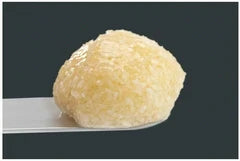
Hyaluronic acid is a natural component of connective tissue, and in dentistry it is used as an adjunct: as a gel in non-surgical and surgical periodontal treatment, to support wound healing, and added to the granules in bone replacement materials. Randomised trials have found faster or better healing in some situations, but the effect depends on the indication and the follow-up period.
What is hyaluronic acid, and where is it used in dentistry?
Hyaluronic acid, also known as hyaluronan, is a long, linear sugar molecule (a glycosaminoglycan) made of repeating units of glucuronic acid and N-acetylglucosamine. It is a major component of the extracellular matrix in soft connective tissue and is found, among other places, in skin, synovial fluid, and periodontal tissues. The molecule is water-soluble, biodegradable, biocompatible, and highly water-binding. This is stated in a review of hyaluronic acid in periodontology published by Pilloni et al. in Periodontology 2000 in 2025.1
In dentistry, hyaluronic acid is used in three roles, and in all three it has been studied as an adjunct to another treatment, not as an alternative:
- as a gel used as an adjunct to non-surgical periodontal treatment and periodontal surgery
- as support for wound healing after surgical procedures
- added to the granules in bone replacement materials
How does hyaluronic acid work?
The Pilloni review compiles laboratory, animal, and clinical studies. The authors describe the roles of hyaluronic acid in several phases of wound healing:1
- Stabilisation of the clot. Platelets contain high-molecular-weight hyaluronic acid, which acts as a scaffold for fibrin in the clot. When applied to the root surface during surgery, hyaluronic acid appears to stabilise the clot.
- Cell migration and proliferation. In laboratory studies, hyaluronic acid promoted the adhesion and proliferation of periodontal ligament cells. In fibroblasts from gingiva and palate, the expression of genes associated with scarless healing was increased.
- Bone-forming cells. In laboratory studies, high-molecular-weight hyaluronic acid promoted the growth of osteoprogenitor cells, and the authors assess that it may help regulate the balance between self-renewal and differentiation during bone regeneration.
- Bacteriostatic effect. Depending on molecular weight and concentration, hyaluronic acid can inhibit certain oral microorganisms in the laboratory.
It is important to distinguish between the levels: the mechanisms have predominantly been shown in laboratory and animal studies. What this means in clinical practice is highlighted by the clinical trials below.
What forms of hyaluronic acid are there?
Pilloni et al. emphasise that there are several types of hyaluronic acid, and that their biological properties depend on the molecule:1
- High- and low-molecular-weight hyaluronic acid. High-molecular-weight hyaluronic acid is described as anti-inflammatory and space-filling, while low-molecular-weight fragments are more pro-inflammatory and angiogenic.
- Cross-linked hyaluronic acid. Natural hyaluronic acid is rapidly broken down by enzymes. With cross-linking, the molecule becomes more resistant and remains in the tissue longer. This is the form that was used in the periodontal trials below.
- Hyaluronic acid in bone replacement. Here, hyaluronic acid is added to the granules, and it is found in both bovine bone substitute (xenografts) and human bone tissue (allografts). Kloss et al. describe that the hyaluronic acid binds fluid when the material is hydrated, so the granules become a cohesive mass, which they call sticky bone.6 The term sticky bone is also used for bone replacement bound with platelet-rich fibrin (PRF), which is another material (read more in What is PRF?).
The sources refer to the products as "Cerabone plus" and "maxgraft + Hya". In this article, the current product names, cerabone® +HyA and maxgraft® +HyA, are used.
What do the studies of hyaluronic acid in dentistry show?
Non-surgical periodontal treatment
A gel with cross-linked hyaluronic acid, applied in the pocket as an adjunct to debridement, resulted in more closed pockets after 3 months, but after 6 months the difference was no longer statistically significant, not even for the primary outcome of the trial, the change in pocket depth. This was found by Iorio-Siciliano et al. in a randomised trial in the Journal of Clinical Periodontology. After 3 months, the pocket was closed (pocket depth ≤ 4 mm without bleeding) in 84.2% of the defects with hyaluronic acid compared to 10.5% without. 38 patients with one moderate intraosseous defect completed the trial, there was no placebo gel, and the authors write that the difference at 3 months may also be due to the fact that the defects in the control group healed more slowly.2
Two gels, sodium hypochlorite with amino acids followed by cross-linked hyaluronic acid, as an adjunct to scaling and root planing, gave an average pocket reduction of 2.9 mm in moderate pockets after 6 months compared to 1.8 mm without, in a randomised trial with 48 patients published by Ramanauskaite et al. in Clinical Oral Investigations. The effect cannot be attributed to hyaluronic acid alone, only systemically healthy non-smokers with good oral hygiene were included, and the authors themselves mention the small sample size as a limitation.3
Clinically, hyaluronic acid gel may be considered as an adjunct to debridement, but none of the trials followed the patients for more than 6 months, and in one the difference was no longer statistically significant at 6 months.2, 3
Periodontal surgery for intraosseous defects
According to the Pilloni review, the most consistent clinical results for hyaluronic acid are seen in regenerative surgery, where hyaluronic acid is used as an adjunct to flap surgery in the same way as enamel matrix derivative (EMD).1 In a randomised trial published by Vela et al. in Oral Health and Preventive Dentistry, hyaluronic acid and EMD both gave statistically significant attachment gain, pocket reduction, and radiographic defect filling after 6 months, with no statistically significant difference between the groups. The trial had no group with flap surgery alone and no histology, and the fact that no difference was found does not mean that the treatments are equivalent.4 In another randomised trial mentioned in the review, hyaluronic acid and EMD gave statistically comparable attachment gain after 24 months, while EMD gave statistically significantly greater pocket reduction.1 Clinically, hyaluronic acid may be considered as an adjunct in regenerative surgery, but the comparison with EMD is based on few trials.
Wound healing
Small clinical trials with 8-36 patients, which the Pilloni review examines, found better clinical healing in some parameters after the extraction of a free gingival graft from the palate and after flap surgery, while a histological split-mouth trial after 24 hours did not find a statistically significant difference in new blood vessel formation.1 Hyaluronic acid can therefore be considered as an adjunct to wound healing, but the evidence consists of small trials.
Bone replacement with hyaluronic acid
As an adjunct to bone building, the most consistent benefits of hyaluronic acid were seen in socket preservation and ridge preservation, including more new bone and less vertical bone loss, in a systematic review of 10 studies with a total of 193 participants published by Hennebelle et al. in Biomedicines in 2026. The effect on ridge width and sinus lift was less consistent, ridge Ridge preservation results rest on 2 randomised trials, and the studies were too different for a meta-analysis. The authors assess that final conclusions cannot yet be drawn, and call for more well-conducted randomised trials.5
The review is predominantly about hyaluronic acid as a gel. Most of the studies used cross-linked hyaluronic acid, usually as a gel.5 The findings therefore cannot be easily transferred to bone replacement, where hyaluronic acid is added to the granules, as in the materials Puredent sells. This form is examined in Kloss et al. and Rakašević et al. below. Read about the principle behind bone building in guided bone regeneration.
Studies of granules with hyaluronic acid
The human allograft maxgraft® +HyA gave less vertical height loss in socket preservation than the same allograft without hyaluronic acid: 0.19 mm compared to 0.82 mm after 4 months. This was found by Kloss et al. in a retrospective comparative study in the International Journal of Implant Dentistry with 40 patients with compromised extraction alveoli, where the alveolus was covered with PRF in both groups. The horizontal measurements and volume did not differ statistically significantly, and implant success 12 months after implantation was without difference between the groups.6 The patients chose themselves whether they wanted hyaluronic acid added, and Hennebelle et al. assess the risk of bias as moderate.5 Read about the procedure in What is socket preservation?
Clinical perspective. maxgraft® + HyA may be considered for socket preservation in compromised alveoli, when the height of the ridge needs to be preserved. The study does not show an effect on the width of the ridge or on implant success, and because it is retrospective without randomisation, the difference in height loss cannot be attributed to hyaluronic acid with certainty.5, 6
The bovine bone substitute cerabone® + HyA gave statistically significantly greater vertical bone gain on X-ray than cerabone® alone at three of four measurement sites after reconstructive surgery of peri-implantitis, while the clinical parameters, including pocket depth and bleeding, were improved in both groups after 6 months without statistically significant difference between them. This was shown in a randomised pilot trial with 13 patients and 19 implants published by Rakašević et al. in the Journal of Functional Biomaterials. The authors describe the results as short-term.7 Read about the disease in What is peri-implantitis?
Clinical perspective. cerabone® + HyA may be considered for reconstructive surgery of peri-implantitis, when the goal is radiographic bone filling of the defect. A clinical benefit over cerabone® alone has not been shown, and the trial is a pilot with few patients and 6 months of follow-up.7
What materials with hyaluronic acid are there?
Puredent sells two bone replacement materials from botiss with hyaluronic acid added to the granules, which are described in the studies above: the bovine cerabone® + HyA, studied for peri-implantitis, and the human allograft maxgraft® + HyA, studied for socket preservation. See the entire range of xenografts and allografts.
-

cerabone® +HyA, 0.5 cc
Bovine bone substitute with hyaluronic acid, granules 0.5-1.0 mm.
See cerabone® +HyA, 0.5 cc → -
cerabone® +HyA, 1 cc
Same material in a 1 cc package, granules 0.5-1.0 mm.
See cerabone® +HyA, 1 cc → -

maxgraft® +HyA, 0.5 cc
Human allograft with hyaluronic acid, granules 0.25-1.0 mm, studied for socket preservation.
See maxgraft® +HyA, 0.5 cc →
Webinars about hyaluronic acid and cerabone +HyA
botiss has recorded webinars and expert talks with clinicians who use the material. Here are three that deal with the biology of hyaluronic acid, healing, and the use of cerabone® + HyA in implantology. They are available at botiss and require a free botissPLUS login.


Frequently asked questions about hyaluronic acid in dentistry
What is hyaluronic acid used for in dentistry?
Hyaluronic acid is used as a gel after debridement or during periodontal surgery, to support wound healing, and added to the granules in bone replacement materials for fx socket preservation and bone building. In the clinical trials, it has been studied as an adjunct, not as a standalone treatment of periodontitis.
Can hyaluronic acid replace debridement?
No. In the clinical trials, hyaluronic acid was used as an adjunct to mechanical debridement. In Iorio-Siciliano et al.'s randomised trial, where 38 patients completed, both groups improved, and the difference in the clinical measurements was only statistically significant at 3 months, not at 6 months.2
What is the difference between cerabone® and cerabone® +HyA?
cerabone® +HyA is the bovine bone substitute cerabone® with added hyaluronic acid. In a randomized pilot study of peri-implantitis with 13 patients, greater vertical bone gain was found on radiographs with cerabone® +HyA than with cerabone® alone, but no statistically significant difference in the clinical parameters.7
Is hyaluronic acid in bone substitutes documented?
A systematic review from 2026 found 10 small clinical studies with a total of 193 participants on hyaluronic acid as a supplement to bone formation. The most consistent benefits were seen in socket preservation and ridge augmentation, while the results in sinus lifts were less consistent. The hyaluronic acid was most often used as a gel, so the findings do not necessarily apply to bone substitutes with hyaluronic acid in the granules. The authors call for more well-conducted randomized trials.5
Have side effects of hyaluronic acid been reported?
In the two randomized trials with hyaluronic acid as a supplement to non-surgical periodontal treatment, where 38 and 48 patients completed, no adverse events or side effects of the gels were reported.2, 3 In the pilot study with bone substitutes for peri-implantitis, two patients experienced a flap dehiscence with exposed collagen matrix after two weeks, without suppuration.7
Interests
We disclose the authors' and Puredent's interests, so you can assess the sources yourself.
- Puredent distributes the bone substitute materials with hyaluronic acid that were studied in sources 6 and 7, and sells courses and textbooks with Richard Miron, who is a co-author of source 1.
- Source 1-4: Anton Sculean is a co-author on all four.
- Source 3: The manufacturer of the gels made them available.
- Source 4: Contains no declaration of conflicts of interest.
- Source 7: The manufacturer of the bone substitute materials provided materials for the study.
- The webinars: Are recorded by the manufacturer of the bone substitute materials. Among the participants are Anton Sculean (source 1-4), Peer W. Kämmerer (source 6) and Dragana Rakašević (source 7).
Sources
- Pilloni A, Shirakata Y, Marini L, Božić D, Miron RJ, Rotundo R, Stavropoulos A, Sculean A. Hyaluronic acid: A novel approach in regenerative/reconstructive periodontal therapy? Periodontology 2000. 2025;99(1):81-108. DOI
- Iorio-Siciliano V, Blasi A, Mauriello L, Salvi GE, Ramaglia L, Sculean A. Non-Surgical Treatment of Moderate Periodontal Intrabony Defects With Adjunctive Cross-Linked Hyaluronic Acid: A Single-Blinded Randomized Controlled Clinical Trial. Journal of Clinical Periodontology. 2025;52(2):310-322 (online 2024). DOI
- Ramanauskaite E, Machiulskiene V, Shirakata Y, Dvyliene UM, Nedzelskiene I, Sculean A. Clinical evaluation of sodium hypochlorite/amino acids and cross-linked hyaluronic acid adjunctive to non-surgical periodontal treatment: a randomized controlled clinical trial. Clinical Oral Investigations. 2023;27(11):6645-6656. DOI
- Vela OC, Boariu M, Rusu D, Iorio-Siciliano V, Sculean A, Stratul SI. Clinical and Radiographic Evaluation of Intrabony Periodontal Defects Treated with Hyaluronic Acid or Enamel Matrix Proteins: A 6-Month Prospective Study. Oral Health and Preventive Dentistry. 2024;22:257-270. PubMed
- Hennebelle L, Reis C, Relvas M, Salazar F, Costa R, Cabral C, Vinhas AS. Hyaluronic Acid as an Adjunct in Bone Regeneration: A Systematic Review. Biomedicines. 2026;14(7):1514. DOI
- Kloss FR, Kau T, Heimes D, Kämmerer PW, Kloss-Brandstätter A. Enhanced alveolar ridge preservation with hyaluronic acid-enriched allografts: a comparative study of granular allografts with and without hyaluronic acid addition. International Journal of Implant Dentistry. 2024;10(1):42. DOI
- Rakašević D, Šćepanović M, Mijailović I, Mišić T, Janjić B, Soldatović I, Marković A. Reconstructive Peri-Implantitis Therapy by Using Bovine Bone Substitute with or without Hyaluronic Acid: A Randomized Clinical Controlled Pilot Study. Journal of Functional Biomaterials. 2023;14(3):149. DOI

Share:
NiTi root canal files: systems, motion, and file sequences
Atraumatic extraction: why preserve the alveolus?