


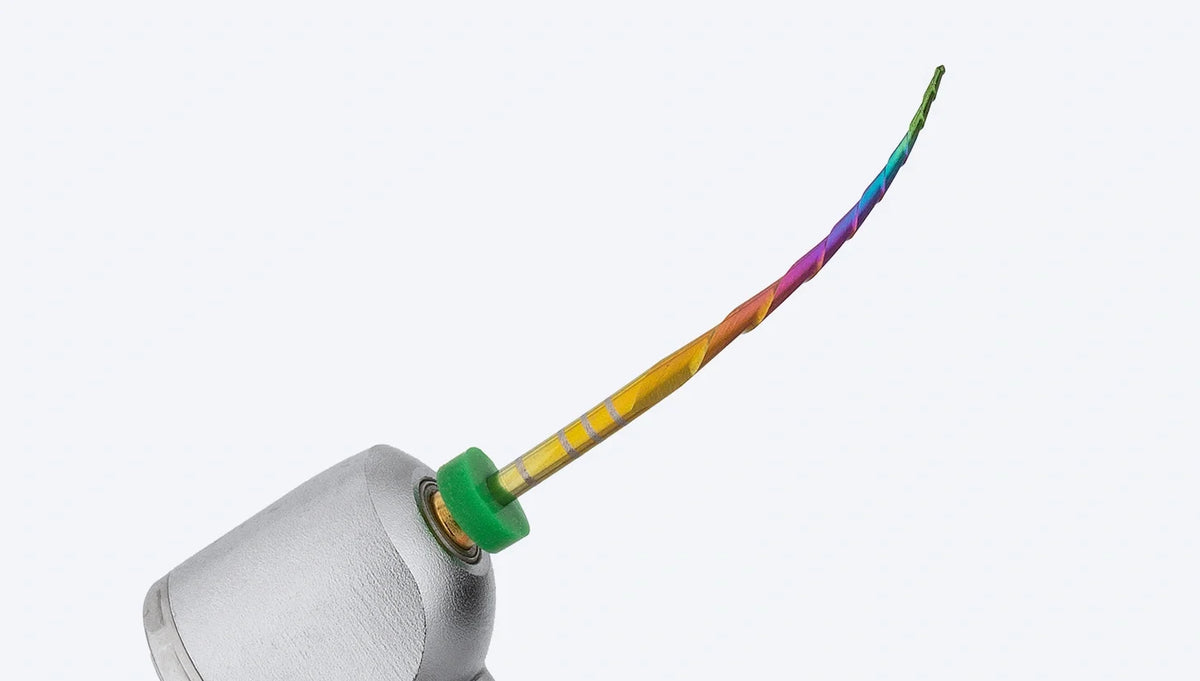
WaveOne Gold, Reciproc Blue and Excalibur are reciprocating files made of heat-treated nickel-titanium (NiTi), where one file usually shapes the canal. Excalibur has 5% taper in all sizes, while the starting files in WaveOne Gold and Reciproc Blue are .07 and .08. In the laboratory, Excalibur withstood the most cycles before breaking, but did not last significantly longer than Reciproc Blue, which withstood the most torque and was the most flexible. Clinical comparisons are lacking.
What characterizes the three reciprocating 1-file systems?
Puredent distributes Excalibur, but not WaveOne Gold or Reciproc Blue. The article is based on the manufacturers' own information and on the studies where all three systems are tested in the same trial.
A reciprocating file rotates back and forth, longest in the cutting direction. With the three systems here, one file usually shapes the canal, and the other sizes are used when the canal is wider. The closer review of NiTi files, file breakage and heat treatment is in the basic knowledge article NiTi root canal files: systems, movement and file sequences.
WaveOne Gold
WaveOne Gold from Dentsply Sirona has four shaping files, Small, Primary, Medium and Large, all with variable taper. The files are gold heat-treated and have a parallelogram-shaped cross-section. The treatment always begins with Primary (25/.07), after the canal is enlarged to at least 0.15 mm with a manual or mechanical glide path file. The motor must run with the approved WaveOne Gold settings, and the user manual does not specify the angles in degrees.8
Reciproc Blue
Reciproc Blue from VDW has three files: R25 with taper .08, R40 with .06 and R50 with .05, all with decreasing taper. The files are blue heat-treated and have an S-shaped cross-section. According to VDW, R25 can be used without a glide path for two-thirds of the estimated working length. The motor must run with the RECIPROC all setting, and VDW's frequently asked questions do not specify the angles in degrees.7
Excalibur
Excalibur from Zarc Endo has four files, E20, E25, E35 and E45, all with 5% taper. The user manual states that the files are made of nickel-titanium, but does not specify the heat treatment. Aranguren et al. describe Excalibur as treated with an advanced heat treatment.3 The file runs 150° counterclockwise and 30° clockwise at 500 revolutions per minute (rpm) and 4 Ncm, and the user manual designates the settings as guidelines. The canal is first enlarged to at least 0.15 mm, and the treatment begins with E25.9 Excalibur is also available as Excalibur PRO, which is not included in the studies below.
WaveOne Gold, Reciproc Blue and Excalibur side by side
The information is from the manufacturers themselves. All three systems are sterile files for single use.7, 8, 9 WaveOne Gold and Reciproc Blue are available in 21, 25 and 31 mm,7, 8 and Excalibur is also available in these sizes at Puredent.
WaveOne Gold
- Brand
- Dentsply Sirona
- Shaping files
- 20/.07, 25/.07, 35/.06 and 45/.05, variable taper
- Starting file
- Primary 25/.07
- Heat treatment
- Gold
- Cross-section
- Parallelogram
- Glide path
- At least 0.15 mm
- Motor
- Approved WaveOne Gold settings
Reciproc Blue
- Brand
- VDW (Dentsply Sirona)
- Shaping files
- R25 (.08), R40 (.06) and R50 (.05), decreasing taper
- Starting file
- R25
- Heat treatment
- Blue
- Cross-section
- S-shaped
- Glide path
- R25 can be used without one for two-thirds of the working length
- Motor
- RECIPROC all setting
Excalibur
- Brand
- Zarc Endo
- Shaping files
- E20, E25, E35 and E45, all 5% taper
- Starting file
- E25
- Heat treatment
- Not specified in the user manual, advanced heat treatment according to Aranguren et al.
- Glide path
- At least 0.15 mm
- Motor
- 150° counterclockwise and 30° clockwise, 500 rpm and 4 Ncm (guidelines)
What do the studies show when the files are tested against each other?
We have found four laboratory studies where all three systems are tested in the same trial, and one clinical study of WaveOne Gold alone.
Fatigue, torsion, flexibility and cutting ability
Excalibur withstood the most cycles before breaking, but measured in time it was not significantly different from Reciproc Blue, which in turn withstood the most torque and was the most flexible. WaveOne Gold lasted the shortest time. This shows the largest of the studies. A laboratory study published by Neto et al. in the International Endodontic Journal in 2026 tested 441 new files from seven reciprocating systems, including Excalibur 25/.05, Reciproc Blue R25 and WaveOne Gold Primary. The main topic of the study was VDW's Reciproc Minima M25 with an even lower taper, which had the longest time to breakage and was the most flexible of all seven. Each mechanical property was measured on 10 files per system, and in the fatigue test each file ran with the angles and speed that the authors state as the manufacturer's recommendation. The numbers are medians.1
| Median | Excalibur | Reciproc Blue | WaveOne Gold |
|---|---|---|---|
| Cycles before breakage | 1,962.5 | 930.0 | 568.8 |
| Time to breakage | 235.5 s | 186.0 s | 97.5 s |
| Torque before breakage | 1.10 Ncm | 1.60 Ncm | 1.20 Ncm |
| Rotation before breakage | 403.5° | 493.0° | 444.0° |
| Force at 45° bend | 362.5 gf | 282.0 gf | 370.0 gf |
| Pressure before bending | 1.85 N | 2.40 N | 1.80 N |
| Force in the cutting test | 136.0 gf | 160.5 gf | 160.5 gf |
In bending and cutting, a lower force is favorable. The fatigue test ran each file at the manufacturer's speed, the cutting test all files at 300 rpm.1 The differences that were significant:
- Cyclic fatigue. The files rotated in a curved steel tube with 86° curvature at room temperature. Excalibur withstood significantly more cycles before breaking than both Reciproc Blue and WaveOne Gold, and Reciproc Blue withstood significantly more than WaveOne Gold. Measured in time, the difference between Excalibur and Reciproc Blue was not significant, but both lasted significantly longer than WaveOne Gold.1
- Torsion. Reciproc Blue withstood significantly more torque before breaking than the other two, and the difference between Excalibur and WaveOne Gold was not significant. Reciproc Blue and WaveOne Gold could be twisted significantly longer before breaking than Excalibur.1
- Flexibility and bending. Reciproc Blue required significantly less force to bend 45° than Excalibur and WaveOne Gold and was therefore the most flexible of the three, while Excalibur and WaveOne Gold were not significantly different. Reciproc Blue also withstood significantly more pressure in the longitudinal direction before bending than the other two.1
- Cutting ability. In this test, Excalibur required significantly less force during the preparation of an artificial canal than Reciproc Blue and WaveOne Gold. All files ran here with 150° and 30° at 300 rpm, which is not Excalibur's or WaveOne Gold's recommended setting, and the authors state that the result is a controlled laboratory comparison and does not show the files' clinical behavior.1
The number of cycles is calculated from the time and the motor's speed. Excalibur ran at 500 rpm, Reciproc Blue at 300 and WaveOne Gold at 350, and the authors themselves state that the angle per cycle is not included in the calculation, so the results should be read as a comparison and not as absolute values. At the test temperature of 20 °C, all three files were predominantly martensitic. At 36 °C, Reciproc Blue was fully austenitic, while Excalibur and WaveOne Gold were in a mixed phase, so all three can behave differently at body temperature.1 Which measure is used matters a lot: In a meta-analysis of 16 laboratory studies published by De Pedro-Muñoz et al. in the Journal of Clinical Medicine in 2024, reciprocating files withstood significantly more cycles than rotating ones, but the difference in time was not significant.6
Clinical perspective. The Neto study speaks for Excalibur when fatigue resistance weighs heavily, but the advantage over Reciproc Blue is only significant when measured in cycles, which depends on the speed. If torsional strength and flexibility weigh the most, the study speaks for Reciproc Blue. The study does not show how the files perform in the clinic.1
Another study of eight reciprocating files
A laboratory study published by Silva et al. in the International Endodontic Journal in 2024 tested 472 new files of eight types, including Excalibur 25/.05, Reciproc Blue R25 and WaveOne Gold Primary. Reciproc Blue withstood the most torque before breaking of all eight. Excalibur and Reciproc Blue were among the files that cut the best, without a significant difference between them, and WaveOne Gold was the least flexible. The authors generally conclude that files with low taper are more flexible and withstand fatigue better, but withstand less torque and provide a narrower apical preparation, which can make it harder for the irrigation fluid to reach. The study is behind a paywall, and we reproduce it based on the abstract.2
Fatigue in 20 file systems
In a third laboratory study published by Aranguren et al. in Materials in 2024, 20 files from each of 20 systems were tested in a steel canal with 60° curvature at room temperature. Excalibur had on average 3,205.3 cycles and 480.8 seconds before breaking, Reciproc Blue 2,454.0 cycles and 368.1 seconds and WaveOne Gold 920.9 cycles and 157.9 seconds.3 The article does not report whether the differences between exactly these three systems were significant, and does not state the speed for each system.3
Shaping of the canal
In a study published by Medina-Gil et al. in Dentistry Journal in 2025, 40 3D-printed mandibular premolars with two canals were prepared with four reciprocating systems, 10 in each group, and measured with micro-computed tomography (micro-CT). Reciproc Blue removed 22.24% of the resin in the pericervical area, WaveOne Gold 17.77% and Excalibur 15.09%. Reciproc Blue removed significantly more than Excalibur, while the difference to WaveOne Gold was not significant. WaveOne Gold was the fastest (86.7 seconds compared to 129.5 for Excalibur), and Reciproc Blue left the fewest untreated canal walls, but none of the differences were significant. There were also no significant differences in the canal's volume and surface.4
The resin is softer than dentin, and the authors state that files with a larger taper can remove more resin than they would remove dentin in a tooth. Excalibur and WaveOne Gold were run on Zarc's Z-EVO motor, WaveOne Gold and Reciproc Blue ran at 400 rpm, and Reciproc Blue was used without a glide path.4
Clinical perspective. The study speaks for Excalibur when a conservative preparation at the canal entrance is the goal, at least compared to Reciproc Blue. The difference is measured in resin, which is softer than dentin, and a narrower preparation can make it harder for the irrigation fluid to reach, according to Silva et al.2, 4
Clinical breakage statistics for WaveOne Gold
A prospective clinical study published by Bueno et al. in the International Endodontic Journal in 2020 followed 1,104 WaveOne Gold files used in 750 molars with curvature under 45°, one file per treatment. None of the files broke. We reproduce the study based on the abstract.5 We have not found similar clinical numbers for Excalibur or Reciproc Blue.
How the studies should be read. The four comparative studies are laboratory studies in steel tubes, artificial canals and printed teeth. They say something about the files' mechanical properties and about the shaping of the canal, not about healing or tooth survival, and the results depend on the test setup, e.g. curvature, temperature and speed. We have not found clinical studies that compare the three systems.
What should you consider when choosing a reciprocating file system?
The three systems have different mechanical strengths in the laboratory, and none of them are documented clinically better than the others. The choice therefore depends on what weighs most in the individual canal:
- Taper and preparation. If a conservative preparation at the canal entrance is the goal, the lower taper and the shaping study speak for Excalibur. The narrower preparation can, on the other hand, place greater demands on irrigation.2, 4
- Fatigue or torsion. If fatigue resistance weighs most, the laboratory studies speak for Excalibur. If torsional strength and flexibility weigh most, they speak for Reciproc Blue. The results depend on temperature, curvature and speed.1, 3 The only clinical breakage study we have found is about WaveOne Gold.5
- Glide path. The user manuals for WaveOne Gold and Excalibur prescribe a glide path of at least 0.15 mm. Reciproc Blue R25 can, according to VDW, be used without one for two-thirds of the working length, but VDW recommends a glide path to size 15 if the hand file does not reach the working length or needs to be pre-bent.7, 8, 9
- The motor. Excalibur runs with its own settings, and the user manual does not mention other systems' programs. If you change systems, check if your motor can be set to 150° and 30° at 500 rpm.9
- Obturation. All three manufacturers have gutta-percha that is adapted to their files, e.g. gutta-percha in Excalibur sizes.7, 8, 10
The Excalibur system at Puredent
If you are considering Excalibur, here are the products from Zarc Endo that belong to the system: the files, Excalibur Glider for glide path, gutta-percha in Excalibur sizes and Zarc's endomotor. Excalibur PRO is not included in the studies above. The descriptions on the cards are the manufacturer's own.
-

-

Excalibur PRO
Reciprocating file in the same sizes as Excalibur, with Zarc's nanocoating.
See Excalibur PRO → -

-

-

Z-EVO endodontic motor
Endodontic motor with continuous and reciprocating rotation and integrated apex locator.
See Z-EVO endodontic motor →
Frequently Asked Questions
What is the difference between WaveOne Gold and Reciproc Blue?
Both are reciprocating files with variable taper. WaveOne Gold is gold heat-treated with a parallelogram cross-section, and Reciproc Blue is blue heat-treated with an S-shaped cross-section.7, 8 In the laboratory study by Neto et al., Reciproc Blue withstood significantly more torque and more cycles before fracture and was more flexible than WaveOne Gold, while the two were not significantly different in the cutting tests.1
Can Excalibur be used on a WaveOne or Reciproc motor?
The Excalibur user manual does not mention the motor programs of other systems. It states that the motor must have the recommended settings for Excalibur, which are 150° counterclockwise and 30° clockwise at 500 revolutions per minute and 4 Ncm, and that the settings are guidelines.9 Therefore, check if your motor can be programmed with its own reciprocating settings.
Which reciprocating file withstood the most fatigue in the laboratory?
In two laboratory studies, Excalibur withstood the most cycles before fracture of the three systems.1, 3 Measured in time, however, the difference between Excalibur and Reciproc Blue was not significant in the Neto study, and the number of cycles depends on the speed at which the file runs.1 The Aranguren study does not report significance, and three of the authors are opinion leaders for Zarc.3 The results come from steel canals at room temperature.
Should a glide path be created before a reciprocating file?
It depends on the system. The user manuals for WaveOne Gold and Excalibur both prescribe a glide path of at least 0.15 mm.8, 9 According to VDW, Reciproc Blue R25 can be used without a glide path for two-thirds of the estimated working length. If the hand file in size 10 cannot reach the working length, or if it must be bent, VDW recommends a glide path to size 15.7
Which reciprocating file removed the least material at the canal entrance in the laboratory?
In a study with 3D-printed resin premolars, Reciproc Blue removed 22.24% of the resin in the pericervical area, WaveOne Gold 17.77% and Excalibur 15.09%.4 The difference between Reciproc Blue and Excalibur was significant, while the difference between Reciproc Blue and WaveOne Gold was not, and the difference between Excalibur and WaveOne Gold is not reported as significant. The resin is softer than dentin, and two of the authors are opinion leaders for Zarc.4
Interests
We disclose the interests of the authors and Puredent, so you can assess the sources yourself.
- Puredent distributes one of the three file systems in the comparison, but not the other two.
- Source 3 and 4 (Aranguren et al.; Medina-Gil et al.): José Aranguren and Alejandro R. Pérez are opinion leaders for Zarc, as is Ana Ramírez-Muñoz. P.S. Ortolani-Seltenerich is an opinion leader for Coltene, which is behind the fourth system in source 4.3, 4
- Source 1 (Neto et al.): The authors declare no conflicts of interest and thank Dentsply Sirona, Micro-Mega and Zarc4Endo for providing the files.1
- Source 6 (De Pedro-Muñoz et al.): The authors declare no conflicts of interest.6
- Source 2 and 5 (Silva et al.; Bueno et al.): We were unable to read the declarations of interest.2, 5
WaveOne and RECIPROC are registered trademarks belonging to Dentsply Sirona, and Excalibur is a registered trademark belonging to Zarc4Endo.
Sources
- Neto F, Martins JNR, Martins RF, Rito Pereira M, Pinto R, Marques D, Braz Fernandes FM, Silva EJNL, Versiani MA, Ginjeira A. Mechanical Performance and Biomechanical Implications of a Reduced-Taper Reciprocating Instrument Compared With 6 Reciprocating Systems. International Endodontic Journal. 2026;59(10):2238-2254. DOI · PubMed Central (freely available)
- Silva EJNL, Peña-Bengoa F, Ajuz NC, Vieira VTL, Martins JNR, Marques D, Pinto R, Rito Pereira M, Braz-Fernandes FM, Versiani MA. Multimethod analysis of large- and low-tapered single file reciprocating instruments: Design, metallurgy, mechanical performance, and irrigation flow. International Endodontic Journal. 2024;57(5):601-616. DOI
- Aranguren J, Oliveros-Porras F, Ramírez-Muñoz A, Pérez I, Salamanca-Ramos M, Aazzouzi-Raiss K, Pérez AR. Comparative Analysis of NiTi Instruments with Different Alloy Treatments. Materials. 2024;17(19):4817. DOI (freely available)
- Medina-Gil M, Martín-Díaz A, Navarrete N, Aranguren J, Ortolani-Seltenerich PS, Malvicini G, Vieira GCS, Pérez AR. Micro-Computed Tomography Analysis of Reciprocating Systems in Three-Dimensional Models of Mandibular Premolars with Two Canals. Dentistry Journal. 2025;13(4):175. DOI (freely available)
- Bueno CSP, Oliveira DP, Pelegrine RA, Fontana CE, Rocha DGP, Gutmann JL, Bueno CES. Fracture incidence of WaveOne Gold files: a prospective clinical study. International Endodontic Journal. 2020;53(9):1192-1198. DOI
- De Pedro-Muñoz A, Rico-Romano C, Sánchez-Llobet P, Montiel-Company JM, Mena-Álvarez J. Cyclic Fatigue Resistance of Rotary versus Reciprocating Endodontic Files: A Systematic Review and Meta-Analysis. Journal of Clinical Medicine. 2024;13(3):882. DOI (freely available)
- VDW. RECIPROC blue: product page and frequently asked questions. Product page · FAQ
- Dentsply Sirona. WaveOne Gold: user manual (IFU rev. 02, 2017) and product page. User manual · Product page
- Zarc4Endo. Excalibur: user manual IFU-0200 rev. 02. User manual
- Zarc4Endo. Gutta-percha: user manual. User manual

Share:
What is extended PRF?
Resorbable vs. non-resorbable membrane in bone augmentation