


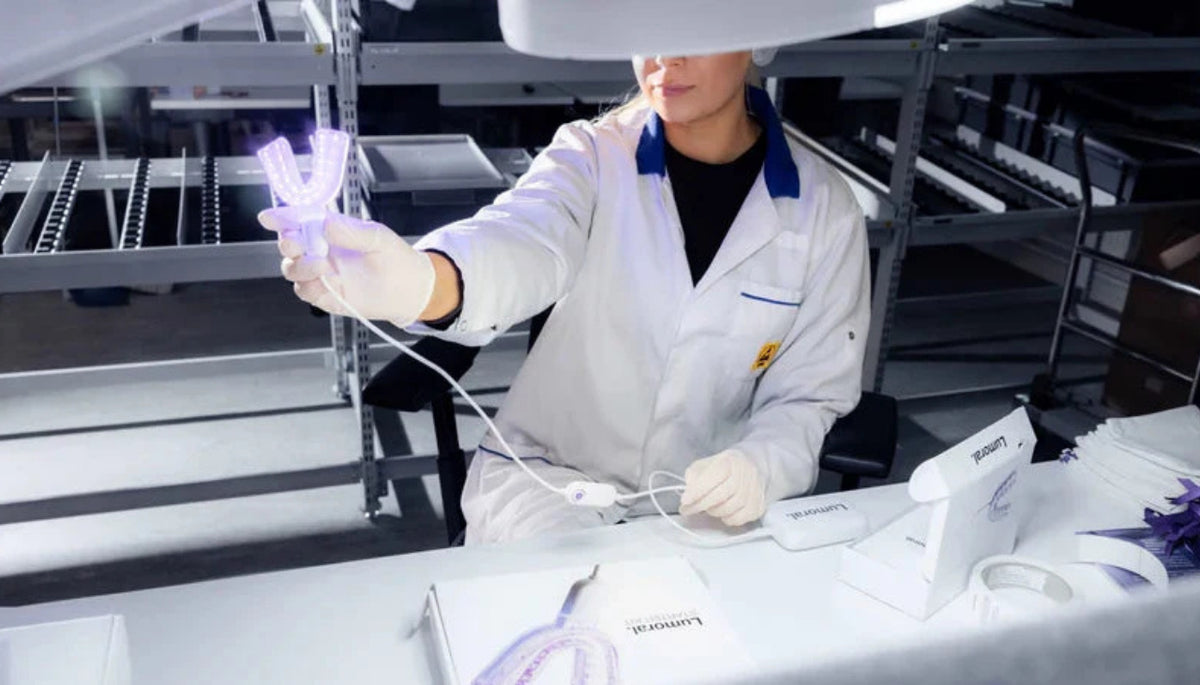
Antimicrobial photodynamic therapy (aPDT) is a treatment where a photosensitive dye in the biofilm is activated by light, creating reactive oxygen compounds that locally inactivate bacteria without antibiotics. In dental care, aPDT is used as a supplement to mechanical treatment for periodontitis and peri-implant disease. Daily aPDT at home has been investigated in randomized trials, where more patients in the maintenance phase achieved low bleeding on probing.
What is antimicrobial photodynamic therapy?
Antimicrobial photodynamic therapy (aPDT) is a non-invasive method to combat bacteria in biofilm without antibiotics. The method requires three things: a dye that absorbs light (a photosensitizer), light at a wavelength that the dye absorbs, and oxygen.
aPDT is used in dental care as a supplement for conditions such as periodontitis and peri-implantitis. This is described by Bessa et al. in a 2022 review in the International Journal of Environmental Research and Public Health, which reviews alternatives to antibiotics in dental care. The background is antibiotic resistance: According to the FDI World Dental Federation, to which the review refers, dentists prescribe around 10% of all antibiotics for humans.1
How does aPDT work?
The photosensitizer settles in the biofilm. When illuminated with light corresponding to the dye's absorption band, reactive oxygen compounds such as singlet oxygen, superoxide, hydroxyl radicals, and hydrogen peroxide are formed in the presence of oxygen, and these are what damage the bacteria. Because the oxygen compounds do not target one specific target in the cell, it is considered unlikely that the bacteria will develop resistance. This is highlighted by Kubizna et al. in a 2024 systematic review in the International Journal of Molecular Sciences.2
The effect depends on the dye and light reaching the biofilm that needs to be treated. The researchers behind the dual-light treatment at home point out that single treatments in the clinic may not be enough for a lasting effect. With daily treatment at home, both dental arches are illuminated at once, and the treatment is repeated.3
What forms of aPDT are there?
The Bessa review mentions toluidine blue, methylene blue, and indocyanine green (ICG) as synthetic photosensitizers that are combined with lasers at different wavelengths.1 In practice, aPDT is available in two forms:
- In the clinic. The dye is applied to the affected areas and illuminated with a laser by the practitioner.1
- At home. The patient rinses their mouth with an ICG mouthwash and then places an LED mouthguard in their mouth, which illuminates both dental arches with blue light (405 nm) and near-infrared light (810 nm). The method is called dual-light because it combines antibacterial blue light and aPDT in one treatment, and it is used daily as part of the patient's own oral care. This is the principle behind Lumoral®.3
What do the clinical studies of Lumoral show?
Daily aPDT at home with Lumoral® has been investigated in randomized trials for periodontitis in the maintenance phase and for peri-implant disease, and in a study of plaque control in healthy adults. All the studies below investigated the home-use form of Lumoral®.
Periodontitis in the maintenance phase
More than twice as many patients achieved bleeding on probing (BOP) below 10% when maintenance treatment was supplemented with daily Lumoral® at home. This was shown in the HOPE-CP trial, which Pakarinen et al. published in 2026 in the Journal of Periodontology. The trial randomized 200 patients with stage I-III periodontitis in the maintenance phase and followed them for six months.3
- 51 % of the patients with Lumoral® had BOP below 10% after six months
- 23 % with maintenance treatment alone (p < 0.0001)
The average BOP fell from 24.2% to 12.0% in the Lumoral group and from 26.1% to 17.3% in the control group (p = 0.0002 for the difference after six months). The number of sites with pocket depth ≥ 4 mm fell from 8.6 to 5.3 with Lumoral® and from 10.6 to 7.8 without (p = 0.027), and the plaque index was also lower in the Lumoral group. The authors conclude that dual-light aPDT may be a promising supplement in the treatment of periodontitis.3
A multicenter trial points in the same direction. In LumoNorth2022, which Tegelberg et al. published in 2026 in the Journal of Periodontology, 40 patients with stage I-III periodontitis at three clinics in Northern Finland were randomized to maintenance treatment with or without daily Lumoral®. BOP fell from 40.2% to 22.0% with Lumoral® and from 35.5% to 26.5% without, and the fall was significantly greater in the Lumoral group after six months (p = 0.03).4
Clinical perspective. Two randomized trials have found less bleeding on probing when maintenance treatment is supplemented with daily Lumoral® at home. Lumoral® for home use can therefore be considered as a supplement in the maintenance phase for patients with stage I-III periodontitis, as investigated in the trials.3, 4 The mechanical and regenerative treatment is described in Treatment of periodontal bone defects.
Peri-implant disease
Bleeding around the implant fell when patients with peri-implant disease used Lumoral® daily at home. Lähteenmäki et al. randomized 40 patients with newly diagnosed peri-implant disease in a 2025 trial in Clinical and Experimental Dental Research to oral hygiene instruction alone or supplemented with daily Lumoral® for four weeks. With Lumoral®, the number of bleeding measurement points around the implant (out of six) fell on average from 4.7 to 1.8 (p < 0.0001), and aMMP-8 in the sulcus fluid fell from 100 to 72 (p = 0.027). In the control group, neither changed significantly (BOP from 3.5 to 3.0).5 An earlier pilot study by the same research group, with seven patients, also found less bleeding and lower aMMP-8.6
Clinical perspective. Lumoral® for home use can be considered as a supplement to mechanical treatment and oral hygiene instruction for implant patients with peri-implant disease.5 How Lumoral® can be incorporated before, during, and after implant treatment is stated in the Lumoral® workflow for implant patients, and diagnosis and treatment are described in Peri-implantitis: what is new in treatment?
Plaque control in patients who already brush well
Plaque also fell in healthy adults with good oral hygiene. Gusseva et al. allowed 30 healthy adults aged 20-25 to use Lumoral® daily for two weeks on top of their regular toothbrushing and flossing in a 2026 crossover pilot study in the Journal of Dentistry, and for two other weeks only regular oral care. During the periods with Lumoral®, the plaque index (median) fell from 1.0 to 0.5, corresponding to 21.2% (p < 0.0001). During the periods with regular oral care alone, the median was 1.0 both before and after (a fall of 6.5%, p = 0.107). All 30 completed the study.7 Puredent has written about the study in Tartu Study: Lumoral® Reduces Plaque in Healthy Adults with Good Oral Hygiene.
Clinical perspective. The authors conclude that daily Lumoral® was associated with a greater short-term fall in plaque than regular oral care alone, even in patients who already brush well. The authors themselves point to patients with implants, braces, bridges, or reduced hand function as relevant groups to investigate.7
Puredent has compiled all the studies of Lumoral® on the page Lumoral Studies.
What do the studies mean for the clinic?
The trials with non-smokers point in the same direction: Daily aPDT at home can supplement professional treatment with less bleeding and better plaque control. For the patient, the treatment becomes part of the daily oral care between visits to the clinic, and for the dentist, it can support maintenance. Whether a patient can benefit from it is the practitioner's assessment. This must be known to assess the results:
- None of the trials could be blinded for the patients, because the device lights up and heats, and there is no placebo device. In HOPE-CP, one and the same investigator measured all patients, and the authors write that the effect may therefore be somewhat overestimated. 13 of the 16 dropouts were in the Lumoral group.3
- LumoNorth2022 was terminated early with 40 instead of the planned 90 patients, and 6 withdrew during the process.4 The trial for peri-implant disease lasted four weeks and compared each group with its own baseline, and the Tartu study was a short pilot study.5, 7
- Smokers are not covered by the results. HOPE-CP excluded smokers. In a trial with 60 smokers with stage III or IV periodontitis, which Vakaki et al. published in 2025 in Clinical Oral Investigations, both groups improved after non-surgical treatment, but daily Lumoral® gave no statistically significant extra difference.3, 8
What do the studies of aPDT as a single treatment in the clinic show?
aPDT given in the clinic as a supplement to subgingival instrumentation gave on average a 0.52 mm greater reduction in pocket depth after six months during active treatment (95% confidence interval (CI) 0.31 to 0.74; 15 trials, 452 participants). This was found by the Cochrane review, which Jervøe-Storm et al. published in 2024 in the Cochrane Database of Systematic Reviews, and which combined 50 randomized trials. The authors assessed the certainty of the evidence as very low and the differences as too small to be clinically important. In 39 of the 50 trials, aPDT was given in one session.9
The results therefore apply to a different form of treatment than Lumoral®: aPDT given once or a few times in the clinic, typically with a laser. For implants, there is still no gold standard for the decontamination of implant surfaces, and decontamination must be combined with mechanical treatment. This is concluded by Dhaliwal et al. in a mini-review from 2021 in Frontiers in Cellular and Infection Microbiology, where photodynamic therapy was one of the investigated methods.10
What Lumoral products are there?
Lumoral® was developed by the Finnish company Koite Health, which Tommi Pätilä, who researches at the Department of Pediatric Heart Surgery at the University of Helsinki, is a co-founder of.3, 7 The patient package is the home-use form that the studies above investigated, and Lumorinse® is the mouthwash that the light activates. The clinic model is used in the clinic before the professional treatment and has not been investigated in the studies. The procedure is stated in the ABT protocol.

-

Lumoral® patient starter package
LED mouthguard and Lumorinse® for the patient's daily aPDT at home.
See Lumoral® patient starter package → -

Lumoral® clinic model
For treating multiple patients in the clinic with the same device and a new sleeve for each patient.
See Lumoral® clinic model → -

Lumorinse® 30 pcs.
Tablets with indocyanine green that dissolve into the mouthwash that the light activates.
See Lumorinse® 30 pcs. →
How does the clinic get started with aPDT?
Puredent has compiled guidance on how Lumoral® can be incorporated into the clinic's workflow on the page Lumoral in the clinic, and the product page for the patient package has suggestions for home protocols for different indications. Which protocol is right for the individual patient is the practitioner's assessment.
See Puredent's upcoming coursesFrequently asked questions about aPDT
What dyes are used in antimicrobial photodynamic therapy?
Does aPDT at home have an effect on periodontitis?
In the HOPE-CP trial with 200 patients in the maintenance phase, 51% achieved bleeding on probing below 10% after six months with daily Lumoral® at home, compared to 23% with maintenance treatment alone. A multicenter trial also found a significantly greater fall in bleeding on probing with Lumoral®.3, 4
Can aPDT be used for peri-implantitis?
aPDT is used as a supplement to mechanical treatment for peri-implant disease. In a randomized trial with 40 implant patients, the number of bleeding measurement points around the implant fell from 4.7 to 1.8 after four weeks of daily Lumoral® at home, while it was virtually unchanged in the control group.5
What is the difference between aPDT in the clinic and at home?
In the clinic, aPDT is most often given as a single treatment with a laser after instrumentation. In 39 of 50 trials in a Cochrane review, the patients received one session.9 At home, aPDT is used daily with a mouthwash and an LED mouthguard that illuminates both dental arches, as part of the patient's own oral care.3
Is aPDT associated with side effects?
In HOPE-CP, no serious side effects related to the device were reported. 13 adverse events related to the device were recorded, e.g. sensitivity, heat sensation and gag reflex, and 7 participants stopped due to discomfort.3 In the Cochrane review, 24 trials with 639 participants reported no side effects related to aPDT in the clinic during active treatment.9
Authors' and Puredent's interests
We disclose the authors' and Puredent's interests so that you can assess the sources yourself.
- Source 3-8: One of the co-founders of the manufacturer Koite Health, who owns shares in the company, is a co-author of all six studies. Koite Health sponsored source 4 and provided the devices for sources 3, 7 and 8. According to source 7, the manufacturer had no role in the design, analysis or interpretation.
- Puredent distributes the equipment for antibacterial light therapy used in sources 3-8.
Sources
- Bessa LJ, Botelho J, Machado V, Alves R, Mendes JJ. Managing Oral Health in the Context of Antimicrobial Resistance. International Journal of Environmental Research and Public Health. 2022;19(24):16448. DOI
- Kubizna M, Dawiec G, Wiench R. Efficacy of Curcumin-Mediated Antimicrobial Photodynamic Therapy on Candida spp.: A Systematic Review. International Journal of Molecular Sciences. 2024;25(15):8136. DOI
- Pakarinen S, Välimaa H, Heikkinen AM, et al. A randomized controlled trial of home-applied dual-light photodynamic therapy during supportive periodontal care (HOPE-CP study). Journal of Periodontology. 2026;97(4):720-731. DOI
- Tegelberg P, Ojala M, Ylipalosaari M, et al. A multicenter, controlled, randomized trial of home-applied dual-light photodynamic therapy in stage I to III periodontitis (LumoNorth2022 study). Journal of Periodontology. 2026. DOI
- Lähteenmäki H, Pätilä T, Räisänen IT, Kalliala R, Sorsa T. Peri-Implant Diseases: Enhanced Antibacterial Photodynamic Therapy. Clinical and Experimental Dental Research. 2025;11(3):e70146. DOI
- Lähteenmäki H, Pätilä T, Räisänen IT, Kankuri E, Tervahartiala T, Sorsa T. Repeated Home-Applied Dual-Light Antibacterial Photodynamic Therapy Can Reduce Plaque Burden, Inflammation, and aMMP-8 in Peri-Implant Disease: A Pilot Study. Current Issues in Molecular Biology. 2022;44(3):1273-1283. DOI
- Gusseva L, Lill LL, Pätilä T, Runnel R. Plaque control by dual-light photodynamic therapy in healthy adults: A randomized crossover pilot study. Journal of Dentistry. 2026;172:106641. DOI
- Vakaki C, Fragkioudakis I, Pätilä T, Sakellari D. Regular home use of dual-light photodynamic therapy as an adjunct to non-surgical periodontal treatment in smokers: a single-center randomized controlled clinical trial. Clinical Oral Investigations. 2025;29(12):553. DOI
- Jervøe-Storm PM, Bunke J, Worthington HV, et al. Adjunctive antimicrobial photodynamic therapy for treating periodontal and peri-implant diseases. Cochrane Database of Systematic Reviews. 2024:CD011778. DOI
- Dhaliwal JS, Abd Rahman NA, Ming LC, Dhaliwal SKS, Knights J, Albuquerque Junior RF. Microbial Biofilm Decontamination on Dental Implant Surfaces: A Mini Review. Frontiers in Cellular and Infection Microbiology. 2021;11:736186. DOI

Share:
What is a collagen matrix for soft tissue reconstruction?
Minimally Invasive Files: TruNatomy vs. SlimShaper