


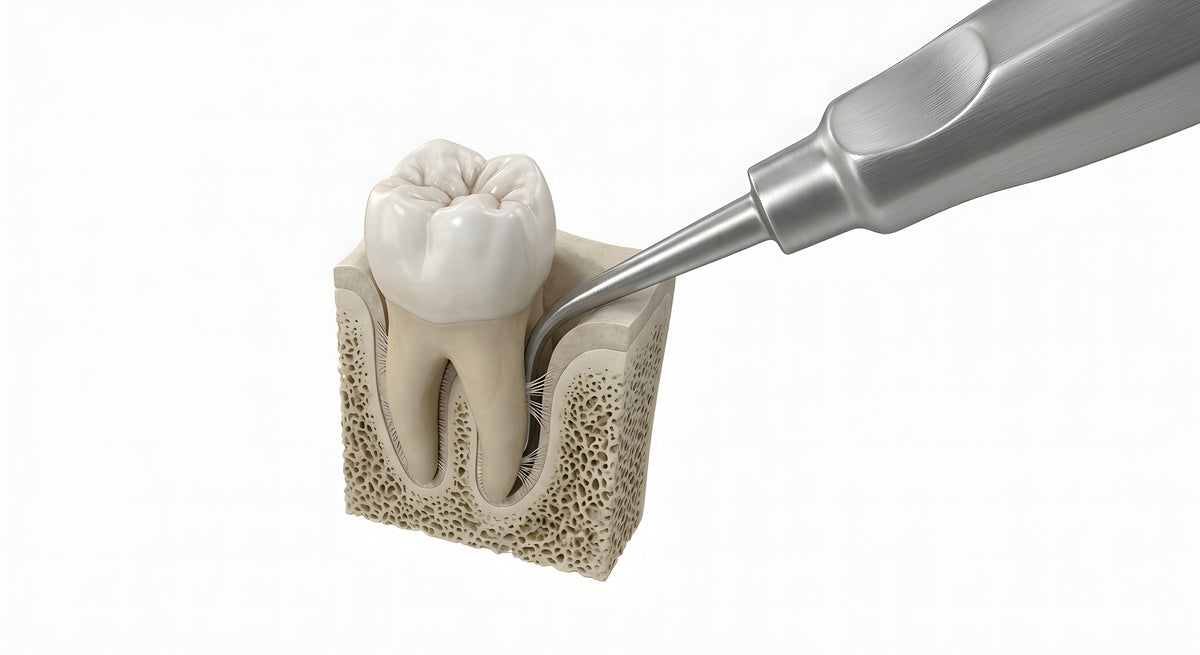
Atraumatic extraction is a tooth extraction where the tooth is loosened at the periodontal ligament instead of expanding the alveolus with force or lifting a flap. The purpose is to spare the buccal bone wall before socket preservation or an implant. For ankylosed roots in the anterior maxilla, 2 out of 40 fractures of the buccal wall occurred with a magneto-electric instrument compared to 18 out of 26 with conventional extraction in a retrospective study.6
What is atraumatic extraction?
When a tooth needs to be removed and the site is later to receive an implant, the extraction itself affects how much of the alveolus remains. In conventional extraction, the tooth is loosened with elevators and forceps that act as a wedge, lever, and wheel and axle. The alveolus is expanded until the tooth can be extracted. If this is not possible, a mucoperiosteal flap is lifted, and bone is removed. This is described by Pujarern et al. in a narrative review in Frontiers in Oral Health from 2026, which synthesizes the literature on healing after extraction and minimally invasive techniques.1 You can find luxators and other hand instruments for extraction in our range.
Atraumatic, or minimally invasive, extraction has the same goal by a different means. According to the review, the techniques use additional equipment to cut the ligament, shift the fulcrum, or pull the root out along its axis, so the tooth and bone are separated with less damage to hard and soft tissues.1
Why should the alveolus be preserved during extraction?
The wall of the alveolus is lined with bundle bone, which is highly dependent on the periodontal ligament for its blood supply. When the tooth is removed, the ligament disappears, and the bundle bone resorbs. The review states that the loss is greatest buccally and in the molar region, that most dimensional changes occur in the first three months, and that remodeling can continue for up to a year. The extent depends, among other things, on the size of the alveolus and the amount of surgical trauma caused by the procedure.1
Surgical trauma can increase resorption. In an animal study referenced by the review, a lifted mucoperiosteal flap with exposed buccal bone could cause an additional reduction of the alveolus by 0.7 mm.1 The finding comes from animals, not from clinical trials. Clinically, this may support avoiding a flap where possible when the alveolus is to be preserved for socket preservation or an implant.
The timing of the implant. The review reports ITI's 2018 consensus with four time points for implant placement: the same day as the extraction (type 1), after 4-8 weeks of soft tissue healing (type 2), after 12-16 weeks of partial bone healing (type 3), and after at least 6 months of full healing (type 4).1
What techniques are available for atraumatic extraction?
Randomized trials comparing the techniques with each other are lacking, and for some, only case reports exist. The authors of the Pujarern review state this themselves and point out that a narrative review may have overlooked studies.1 Overall, the strength of the evidence varies: Periotom, piezosurgery, and physics forceps have been investigated in randomized trials. For vertical extraction, there is one randomized trial in addition to observational studies.1 For the magnetic mallet, the review refers to two studies: one without a control group and one retrospective study with a control group.5, 6
Periotom
A thin blade is inserted into the periodontal ligament and cuts the fibers, so the tooth can be removed with minimal lateral force. In a double-blinded randomized trial with 100 patients and single-rooted teeth, referenced by the review, the periotom resulted in significantly less postoperative pain and fewer gingival lacerations than conventional extraction, and the procedure took an average of 5.78 minutes compared to 12.81 minutes.1
Clinical significance. The periotom may be considered for single-rooted teeth where pain and soft tissue damage need to be limited.
Piezosurgery
Piezoelectric instruments cut hard tissue with ultrasonic vibrations, and the review highlights the precise tactile control. In a study comparing piezosurgery with conventional extraction in patients who needed teeth removed on both sides, piezosurgery resulted in a better pain score after the procedure and less bleeding and swelling according to the patients' own reports.1 In a randomized trial comparing the periotom and piezotom, the piezotom was gentle on soft tissue but no better than the periotom: The procedure took about 3 minutes longer, and the pain during the procedure was significantly higher. Based on the trial, the review concludes that the periotom may be preferable. In another comparative study, the piezotom resulted in more marginal bone loss immediately after the procedure than the periotom, but no difference after 6 months.1
Clinical significance. Piezosurgery may be considered instead of conventional extraction based on patients' own reports of pain, bleeding, and swelling. The studies do not provide grounds for preferring the piezotom over the periotom.
Magnetic (electric) mallet
A thin instrument is driven in short, axial pulses into the ligament space, so the root is loosened from the bone with minimal hand force. According to the review, it requires significantly less force than conventional periotoms.1 The studies are compiled in the section on the studies of the Magnetic Mallet.
Physics forceps
Forceps with one lever and a soft buccal support at the mucogingival junction, which distributes the force. A systematic review with meta-analysis of randomized trials, referenced by the Pujarern review, found better results than conventional forceps in areas such as time, pain, and tissue trauma, but with a high risk of bias and low certainty of evidence. In a study with 200 patients, also referenced by the review, root and crown fractures were more frequent with conventional forceps, while the number of fractures of the buccal bone wall was comparable in the two groups.1
Clinical significance. Physics forceps may be considered instead of conventional forceps.
Vertical extraction
A screw is anchored in the root canal, and the root is pulled out along its axis without a flap. The method is more successful with single-rooted than multi-rooted teeth: In two observational studies referenced by the review, the success rate was 83% overall in one, and according to the review, the failures occurred in multi-rooted teeth, and 87.2% for single-rooted compared to 69.7% for multi-rooted teeth in the other. However, in a randomized trial comparing vertical and conventional extraction, a significant volume loss and aesthetic impact on the soft tissue of the adjacent teeth were observed in both groups.1
Clinical significance. Vertical extraction may be considered especially for single-rooted teeth with little or no crown remaining, where the alternative would otherwise be a flap.
Socket shield and root sectioning
With the socket shield technique, a thin buccal root fragment is deliberately left behind, so the ligament and bundle bone are preserved. With root sectioning, multi-rooted teeth are divided so that the roots can be removed individually without large luxation forces.1
Clinical applications and what the studies show
Before socket preservation and a later implant
Atraumatic extraction is typically the first step when the alveolus is to be filled and the implant placed later. It has been used this way in randomized trials with socket preservation, but the trials did not compare extraction techniques. In the trial published by Brahma Prasad Chary et al. in The Journal of Indian Prosthodontic Society in 2021, the tooth was removed with periotoms and luxators, the alveolus was filled with advanced platelet-rich fibrin (A-PRF), and the implant was placed after 6 or 8 weeks.2 Sirinirund et al. used an extraction without a flap in a study in the Journal of Periodontology from 2025 and compared operating microscope with loupes during the debridement of the alveolus.4 The trials therefore say something about the timing of the implant and about the debridement, not about the extraction technique itself.
If the alveolus is to be filled after extraction, biomaterials or platelet-rich fibrin (PRF) produced with PRF equipment may be considered. Materials and evidence are reviewed in the article on socket preservation, and PRF is explained in our guide to Platelet-Rich Fibrin.
For immediate implantation in infected alveoli
Immediate implantation in infected alveoli may be possible in carefully selected cases, and atraumatic extraction, thorough debridement, and primary stability are consistently described as key steps, but a standardized protocol cannot yet be recommended. Espada-Salgado et al. conclude this in a scoping review in Medicina Oral, Patología Oral y Cirugía Bucal from 2026. The review reviewed 24 clinical studies from 2015 to 2025, mostly case reports, case series, and cohort studies, and only one randomized trial.3
Clinical significance. Atraumatic extraction is one of the steps described by the studies when immediate implantation in an infected alveolus is considered.
How is an ankylosed tooth removed?
According to the review, ankylosed teeth belong to complex extractions, and if the tooth cannot be removed with conventional instruments, the alternative is often a flap and removal of bone.1 Here, the magnetic mallet has been investigated, see the section on Magnetic Mallet.
Clinical significance. For ankylosed teeth, a magnetic mallet may be considered when the alternative is a flap and bone removal.
What do the studies of Magnetic Mallet show?
Two studies with Crespi as first author have investigated an electric or magneto-electric mallet for extraction. The review refers to the instrument in the 2014 study as Magnetic Mallet and shows Magnetic Mallet from Osseotouch as an illustration, but neither the review nor the abstracts state which brand the studies used.1 The studies are not freely available, and we have read their abstracts on PubMed.
- Crespi et al. described in the Journal of Craniofacial Surgery in 2014 the extraction of 427 teeth with no prospect of preservation in 156 patients with an electric mallet. On X-rays taken immediately after extraction, no fracture or loss of the cortical bone wall was seen, and all alveoli had secondary soft tissue healing after 2 weeks. The study has no control group.5 The Pujarern review describes the teeth as ankylosed, but it is not stated in the study's abstract.1
- Crespi et al. compared in the Journal of Cranio-Maxillofacial Surgery in 2023 a magneto-electric instrument with conventional extraction of ankylosed teeth in the anterior maxilla (incisors and premolars). The study is retrospective and based on journal data from 66 patients with one tooth each. With the magneto-electric instrument, 2 out of 40 fractures of the buccal bone wall occurred compared to 18 out of 26 with conventional extraction, and 4 out of 40 required sutures compared to 18 out of 26.1, 6
The authors of the review point out that the percussive impulses can transfer load to the buccal wall, especially where the bone is thin. They list relative contraindications: neurological disorders such as epilepsy, recent implant placement or bone grafting nearby, inner ear disorders or dizziness, severely ankylosed teeth, pacemakers, and patients who do not tolerate percussion.1
Clinical perspective. For ankylosed teeth in the anterior maxilla, the study suggests fewer fractures of the buccal wall and fewer sutures with a magneto-electric instrument than with conventional extraction.6 Magnetic Mallet is an instrument of the same type, so it may be considered when an ankylosed tooth needs to be removed without a flap and bone removal. The controlled study only included the maxilla.
When can which technique be considered?
The choice depends on the tooth, root, and bone. According to the Pujarern review, none of the instruments have absolute contraindications, and the choice depends on the case, anatomy, and the practitioner's experience.1 Ordered by clinical situation:
- Single-rooted tooth with crown: periotom. The periotom was faster and caused less pain than conventional extraction in a randomized trial.1
- Little or no crown remaining: vertical extraction, where the success rate was higher for single-rooted than for multi-rooted teeth.1
- Ankylosed tooth: magnetic mallet, with fewer fractures of the buccal wall than conventional extraction in the study with a control group.6 The review's relative contraindications are under Magnetic Mallet.
- Instead of conventional forceps: physics forceps, with fewer root and crown fractures.1
- Multi-rooted tooth: root sectioning, so the roots can be removed individually.1
- Buccal bone to be preserved for an implant: socket shield technique, where a thin buccal root fragment is deliberately left behind.1
- Infected alveolus before immediate implantation: atraumatic extraction and thorough debridement are described as key steps.3
The alternative to all techniques is conventional surgical extraction, which according to the review may be preferable when access is limited, the bone is very dense, or patient conditions increase the risk of the procedure.1
What instruments and materials are used?
The conventional part of the extraction is handled with luxators. For extraction with a magnetic mallet, the unit itself and extraction instruments are used, and if the alveolus needs to be filled afterwards, PRF may be considered (see applications). Here are the products that belong to the techniques in the article:
-

Magnetic Mallet Starter Kit
Magnetic Mallet with foot pedal and handpiece for tooth and implant surgery. The instruments are selected separately.
See Magnetic Mallet Starter Kit → -

Extraction Instruments
Instruments for tooth extraction in surgical steel, individually or as a set.
See extraction instruments → -

Easyroot Starter Kit
Easyroot with foot pedal, extraction handpiece, and three extraction instruments.
See Easyroot Starter Kit → -

Complete PRF setup
Equipment for producing PRF for the alveolus after extraction.
See Complete PRF setup →
Where can you learn atraumatic extraction?
According to the Pujarern review, the choice of instrument depends on several factors, including the practitioner's experience.1 Puredent holds courses in oral surgery, implantology, and PRF.
See upcoming coursesFrequently asked questions about atraumatic extraction
What is the difference between atraumatic and conventional extraction?
In conventional extraction, the alveolus is expanded with elevators and forceps, and if necessary, a flap is raised, and bone is removed. In atraumatic extraction, the tooth is loosened at the periodontal ligament with instruments that cut the ligament, move the fulcrum, or pull the root out along its axis. The goal is to spare the buccal bone wall and soft tissue.1
What instruments are used for atraumatic extraction?
The Pujarern review describes, among others, peri-otomes, piezo surgery, magnetic mallet, physics forceps, and vertical extraction systems. In addition, socket shield technique and root sectioning are mentioned.1
Does atraumatic extraction take longer?
It depends on the technique. In a randomized trial with 100 patients and single-rooted teeth, extraction with a peri-otome took an average of 5.78 minutes compared to 12.81 minutes with the conventional technique, while the piezo-otome in another trial took around 3 minutes longer than the peri-otome.1
Can Magnetic Mallet be used for ankylosed teeth?
This has been investigated. In a retrospective study of ankylosed teeth in the anterior maxilla, 2 out of 40 fractures of the buccal wall occurred with a magnetoelectric instrument compared to 18 out of 26 with conventional extraction.6 The Pujarern review mentions severely ankylosed teeth among the relative contraindications.1
Should the alveolus be filled after atraumatic extraction?
It depends on the plan for the site. Atraumatic extraction limits surgical trauma, but the bone still resorbs after tooth loss. If an implant is to be placed later, socket preservation may be considered. It is a clinical assessment made by the treating dentist.1
Can you avoid raising a flap during extraction?
It may be possible. Vertical systems are designed to remove the root without a flap, and the peri-otome and magnetic mallet loosen the tooth without expanding the alveolus. Vertical extraction was successful in 87.2% of single-rooted and 69.7% of multi-rooted teeth in an observational study, and if it failed, conventional extraction or flap surgery was performed.1
Authors' and Puredent's interests
We disclose the authors' and Puredent's interests so that you can assess the sources yourself.
- Source 1, 2, and 4: The authors declare that they have no conflicts of interest. Source 4 is supported by the Delta Dental Foundation.1, 2, 4
- Source 6: The authors declare that they have no conflicts of interest.6
- Source 5: The declaration is not in the abstract, and the study is not freely available.
- Puredent sells instruments for extraction with magnetic mallet and equipment for PRF.
Sources
- Pujarern P, Srisawan W, Chuenjitkuntaworn B, Thiradilok S, Rokaya D, Suphangul S. Minimally invasive tooth extraction: the science and clinical strategies of socket preservation: a comprehensive review. Frontiers in Oral Health. 2026;7:1834419. DOI
- Brahma Prasad Chary NO, Raju MS, Suresh Sajjan MC, Gottumukkala SN, Manyam R. Comparison of quality of bone and insertion torque values of early implants placed at 6 and 8 weeks in sockets preserved with advanced platelet-rich fibrin: A randomized controlled trial. Journal of the Indian Prosthodontic Society. 2021;21(4):366-374. DOI
- Espada-Salgado FM, Iuga MM, Oprea B. Immediate implant placement in infected extraction sockets: A scoping review of case selection, decontamination protocols, clinical outcomes and complications. Medicina Oral, Patología Oral y Cirugía Bucal. 2026;31(5):e758-e771. DOI
- Sirinirund B, Zalucha J, Rodriguez Betancourt AB, Kripfgans OD, Wang CW, Velasquez D, Chan HL. Clinical outcomes of using operating microscope for alveolar ridge preservation: A randomized controlled trial. Journal of Periodontology. 2025;96(3):230-240. DOI
- Crespi R, Bruschi GB, Capparè P, Gherlone E. The utility of the electric mallet. Journal of Craniofacial Surgery. 2014;25(3):793-795. DOI
- Crespi R, Toti P, Covani U, Trasarti S, Crespi G, Menchini-Fabris GB. Conventional avulsion versus less traumatic extraction of ankylosed roots with a magnetoelectric device in anterior maxillary areas. Journal of Cranio-Maxillofacial Surgery. 2023;51(12):760-765. DOI

Share:
What is hyaluronic acid in implantology?
Sinus lift: lateral window vs. crestal technique